
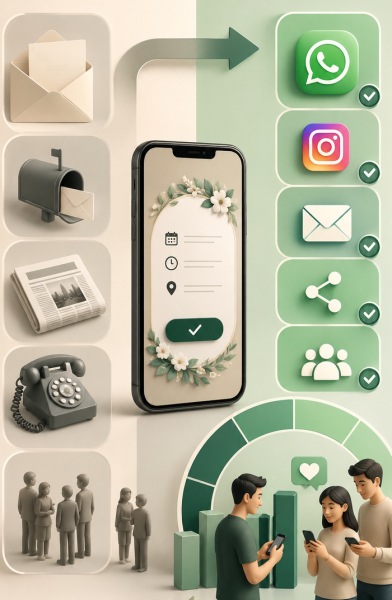



Not all channels work the same, and choosing the wrong one can leave you with a guest list full of uncertainty and a catering budget at risk.
This article uses data and practical criteria to analyze which digital RSVP method performs best depending on the type of event. It's not about repeating what wedding blogs say. It's about understanding the actual behavior of guests and making an informed decision.
Most organizers assume that sending a digital invitation is enough. The guest receives the message, opens the link, confirms, and that's it. But the reality is very different. According to consolidated data from multiple event management platforms for 2025-2026, the average attendance rate for in-person events is 68% , meaning that almost one in three guests who say they will attend ultimately don't show up.
At free events, the no-show rate can reach 40-50%, while at paid events it drops dramatically to 3-10%. This demonstrates that guest engagement depends directly on the difficulty they face in confirming their attendance and the perceived value of the event.
The common mistake is thinking that all communication channels have the same conversion power. A WhatsApp message doesn't behave the same way as a QR code printed on a card, or a link sent by email. Each channel has a different open rate, response rate, and level of friction. Ignoring these differences is like planning an event blindly.
WhatsApp is the most familiar communication channel for most people. In Latin America and Spain, practically everyone uses it daily. This makes it a tempting option for managing RSVPs. However, its main advantage is also its main weakness.
WhatsApp invitations are informal and conversational. Guests receive a direct message, read it almost immediately, and can respond with a simple yes or no. But here's the first problem: there's no centralized guest list.
If you send 100 individual messages, you need to manually track who replied and who didn't. If you create a WhatsApp group, the information gets lost among messages from other participants, stickers, and side conversations. According to a comparative analysis of RSVP platforms, WhatsApp presents a high risk of missed replies and extremely difficult change management.
Furthermore, WhatsApp lacks structure. A guest might confirm their attendance in a message but forget to mention they're bringing a guest or have dietary restrictions. Then, when you ask for those details, the message gets lost in the chat, leaving you with a spreadsheet full of gaps.
For small, informal events, like a get-together with friends or a family dinner, WhatsApp can work. But for weddings, corporate events, or any celebration where you need structured data, it's a trap. The familiarity of the channel is deceiving: it seems easy, but it forces you to do all the administrative work manually.
The QR code has become a symbol of modernity for events. It's printed on physical invitations, projected on screens, and shared on social media. The idea is simple: the guest scans the code with their phone, accesses a digital form, and confirms their attendance. It sounds perfect, but the effectiveness of the QR code depends heavily on the context.
At corporate events and professional conferences, QR codes work exceptionally well. Attendees are accustomed to scanning codes to access information, register, or connect to Wi-Fi networks. According to data from event management platforms, QR code check-in combined with pre-confirmation achieves 99% accuracy and can reduce the need for on-site staff by up to 30%. This makes it the ideal option for events where logistics and access control are paramount.
However, at social events like weddings or birthdays, QR codes have significant limitations. First, they require guests to receive a physical or digital invitation with the code printed on it. If the digital invitation is sent by email, the guest must open the email, view the code, take out their phone, and scan it. This process is more cumbersome than it seems. Second, older adults or people with limited technological familiarity may feel intimidated by QR codes and choose not to respond at all.
Another critical point is that the QR code alone doesn't send reminders. Unlike WhatsApp or SMS, where you can send a follow-up message, the QR code is passive. If the guest scans it but doesn't complete the form, you have no way of knowing or contacting them to remind them to confirm.
A confirmation link sent via email, SMS, or direct message is the most flexible method and, when implemented correctly, the most effective. The key lies in how the link is sent and the experience the guest encounters upon clicking it.
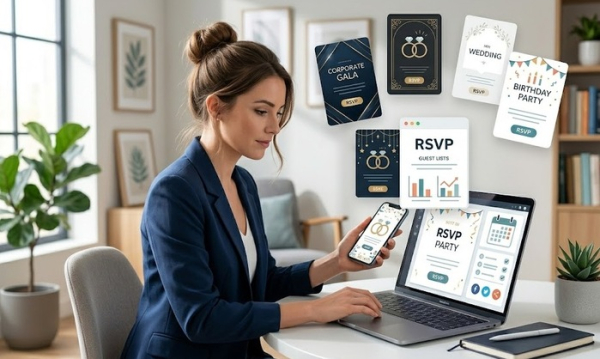
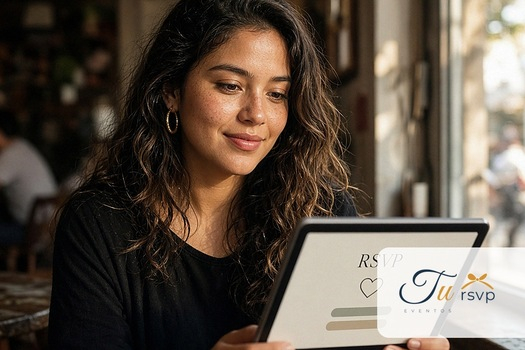
Specialized digital RSVP platforms offer mobile-optimized forms where guests can RSVP, list guests, select menu items, and leave comments—all in one step. The information is automatically centralized in a graphical spreadsheet that the organizer can export and manage effortlessly. This eliminates the chaos of WhatsApp and overcomes the limitations of QR codes.
But not all links are created equal. A link sent via email has an open rate of only 20-30%, far lower than the 98% open rate of text messages. This means that if you send your RSVP only by email, you're excluding most of your guests . The solution is to combine channels: send the link via SMS to maximize open rates, and offer a QR code as an alternative for those who prefer to scan from a printed invitation.
According to data from SMS-based RSVP platforms, response rates per text message range from 45% to 55%, well above the 5-10% response rate per email.
Furthermore, events that use automated SMS reminders reduce no-show rates by up to 25-30%. This demonstrates that the delivery channel matters just as much as the form itself.
This is a table that summarizes which method works best depending on the type of event, considering expected response rate, ease of management for the organizer, and guest experience.
| Event type | Recommended channel | Expected response rate | Ease of management | Friction level for the guest | Structured data | Automatic reminders | Ideal for seniors | Final check-in accuracy |
|---|---|---|---|---|---|---|---|---|
| Small, informal events | 30-40% | Manual descent | Low | No | No | Yeah | Low | |
| Corporate events and conferences | QR Code | 50-60% (with check-in) | Media (requires platform) | Medium (requires scanning) | Yeah | No | No | 99% |
| Weddings and medium-sized social events | Link via SMS | 45-55% | High (automatic) | Low | Yeah | Yeah | Yeah | High |
| Formal corporate events | Link via email | 5-10% | Media (requires monitoring) | Stop (check spam, open later) | Yeah | Yeah | Yeah | High |
If you're organizing an event and need a platform that combines RSVP confirmations, automatic reminders, and centralized guest management, visit tursvp.com. It's the tool you need to stop chasing answers and start enjoying the planning process.
-18-29-22-0506192954.png)
Visual comparison of response rates by channel. SMS and optimized links significantly outperform email and WhatsApp at formal events. Source: Consolidated data from event management platforms 2025-2026.
For weddings, birthdays, or corporate events where every RSVP counts, tursvp.com gives you the control that WhatsApp and paper invitations can't offer. Discover how it works at tursvp.com.
Weddings are the type of event where the RSVP method is most debated. Couples want something elegant, but they also need precise information: who's attending, with whom, dietary restrictions, and accommodation preferences. In this scenario, a confirmation link sent via SMS or WhatsApp with an embedded link is the winning option.
Wedding platforms like Zola, Joy, and The Knot offer free digital RSVPs that integrate confirmation with the wedding website, seating chart, and guest list. These tools allow you to send the link through multiple channels and track who has responded in real time.
The trick is in the sending: sharing the link via WhatsApp works well if it's done individually and with a personalized message, not in a generic group.
However, there's a worrying statistic. On wedding planning forums, many couples report initial response rates of 20% or less two weeks after sending invitations. This means that, regardless of the channel, reminders are essential. Platforms that allow for automated reminders via SMS or email have a decisive advantage over manual methods.
For weddings with older or less tech-savvy guests, a hybrid strategy works best: send the physical invitation with a printed QR code, but also send the link via WhatsApp or SMS to your closest contacts. This way you cover all the bases without leaving anyone out.
In the corporate world, precision is everything. A conference organizer needs to know exactly how many people will attend in order to manage catering, chairs, printed materials, and support staff. Here, QR codes shine during check-in, but not so much during pre-confirmation.
The best practice for corporate events is a two-step approach. First, send the registration link via SMS or corporate email with a structured form that captures all the necessary information: name, company, job title, dietary restrictions, and sessions of interest. Second, generate a unique QR code for each confirmed attendee, which is scanned upon entry to the event to validate attendance and grant access to restricted areas.
This hybrid method leverages SMS's high open rate (98%) for confirmation and QR code accuracy for access control. Platforms like RSVPify and EventX offer this full integration, synchronizing responses with CRM systems and dashboards in real time.
A key statistic for internal corporate events: attendance rates are typically 72-82%, significantly higher than for events open to the public. This is because employees have a greater sense of organizational commitment. Even so, automated SMS reminders reduce no-shows and improve punctuality.
For birthday parties, family gatherings, or celebrations with friends, WhatsApp remains the preferred channel due to its immediacy and familiarity. But even in these informal contexts, sending a simple text message saying "please confirm if you're coming" isn't enough.
The recommendation is to use WhatsApp as a distribution channel, but not as a data collection tool. In other words, send a WhatsApp message that includes a link to a simple digital form. This way, you take advantage of WhatsApp's high read rate (messages are read in minutes) while avoiding the chaos of managing scattered responses across individual or group chats.
For small gatherings of fewer than 20 people, a simple WhatsApp message can work. But when the guest list grows or you need to know specific details (like who will bring dessert or how many children will be attending), a digital RSVP form becomes indispensable. According to analyses of RSVP platforms, digital confirmation pages offer significantly better control and visibility than informal WhatsApp messages.
-18-34-10-0506193432.png)
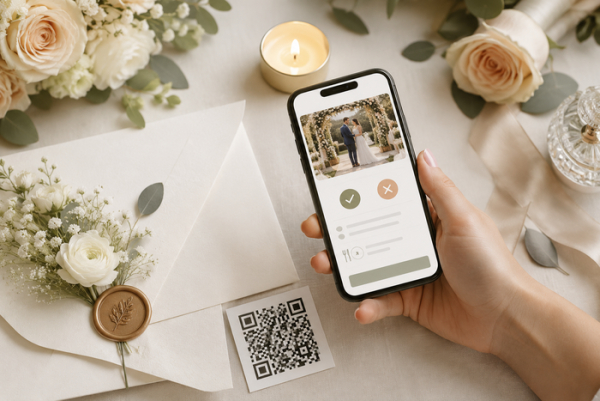
Recommended workflow for weddings: physical invitation with QR code, SMS follow-up with a link to a digital form, and automated reminders. Source: adapted from best practices of the Zola and RSVPify platforms.
The digital RSVP landscape is evolving rapidly. The most advanced platforms already integrate artificial intelligence to send personalized reminders at the optimal time, automatically answer frequently asked guest questions, and predict no-show rates based on historical behavior.
RSVP chatbots allow guests to confirm attendance, modify their RSVP, or ask questions about the event without directly interacting with the organizer. This reduces the administrative burden and improves the guest experience. Furthermore, integration with digital calendars and map applications allows RSVPs to automatically add the event to the guest's calendar and send them traffic or weather notifications on the day of the event.
By 2026 and beyond, the trend points to hybrid systems that combine multiple channels (SMS, WhatsApp, email, QR) into a single management platform, where the organizer configures once and the system automatically decides the best channel for each guest based on their response history and communication preferences.
After analyzing data, platforms, and guest behavior, my direct recommendation is this: don't choose just one channel. The most effective method in 2026 is a multichannel strategy where SMS or WhatsApp serve as the link distribution channel, the digital form as the data collection point, and QR codes as an alternative for guests receiving physical invitations. But above all, invest in a platform that allows you to send automatic reminders.
The difference between a 20% response rate and a 55% response rate isn't in the channel; it's in persistent, well-timed follow-up. Guests aren't bad at RSVPing; they're simply busy and need to be reminded that responding matters.
There's no single perfect digital RSVP method for every event. WhatsApp works for informal RSVPs but relies on manual management. QR codes are elegant and precise for check-in, but too passive for pre-confirmation. SMS links offer the best balance of response rate and ease of management, but depend on a well-implemented platform.
The key is understanding your guests' profiles and the level of formality of your event. For weddings and social events, prioritize sending the link via SMS or WhatsApp with automatic reminders. For corporate events, combine digital registration with QR codes for access control. And for small celebrations, WhatsApp can be sufficient as long as you know you'll be handling the administrative tasks manually.
What is certain is that in 2026, organizing an event without a structured digital RSVP system is an unnecessary risk. The data is available, the tools are accessible, and the difference between a chaotic event and a well-planned one lies in choosing the right channel and using it consistently.
Don't let a lack of responses ruin your event. With tursvp.com, your guests RSVP in seconds and you see everything in real time. Get started now at tursvp.com
-
-
-
-
-
-
-
-
-
- Nunify. In-Person Event Attendance Rate: Latest 2025-2026 Benchmarks. 2026. https://www.nunify.com/blogs/event-attendance-rate
- Evant App. Why SMS RSVP Tools Outperform Other RSVP Solutions: A Comprehensive Comparison. 2026. https://www.evant.app/blog/why-sms-rsvp-tools-outperform-other-rsvp-solutions-a-comprehensive-comparison
- Eventwall. Digital RSVP vs WhatsApp RSVPs: What Actually Works Better? 2025. https://evntwall.com/digital-rsvp-vs-whatsapp-rsvps-what-actually-works-better/
- We Have a Wedding. Wedding RSVP. 2025. https://www.habemusboda.com/confirmacion-asistencia-boda/
- Zola. The Best Online Wedding RSVP Tools. 2026. https://www.zola.com/expert-advice/best-online-wedding-rsvp-tools
- Reddit r/weddingplanning. What is/was your RSVP response rate like? https://www.reddit.com/r/weddingplanning/comments/tt1c15/what_iswas_your_rsvp_response_rate_like/
- Calendar Snack. Crunching the Numbers: The RSVP Response Rate. https://calendarsnack.com/rsvp-response-rate/
If «RSVP via WhatsApp, QR code, or link: Which confirmation method works best depending on the type of event?» leaves the thread open, the natural next reads are «Why digital invitation platforms are failing in user experience and how events in Mexico are paying the price» and «The digital invitation market: leaders, opportunities, and strategies to scale your business». . On TuRSVP that lands in «NULL».
Enviando comentario…
 EmiteDocs
Constancias, diplomas, oficios y contratos en lote.
EmiteDocs
Constancias, diplomas, oficios y contratos en lote.
 CrearPlantillas
Editor visual de anuncios, plantillas y collage.
CrearPlantillas
Editor visual de anuncios, plantillas y collage.
 TuRSVP
Invitaciones digitales con RSVP para eventos.
TuRSVP
Invitaciones digitales con RSVP para eventos.
 Minitareas
Tableros personales para organizar el trabajo.
Minitareas
Tableros personales para organizar el trabajo.
 Cotización de páginas web
Arma tu sitio por módulos y cotiza en MXN.
Cotización de páginas web
Arma tu sitio por módulos y cotiza en MXN.
 Convertidor de formatos
Convierte Excel, Word, PDF, imágenes y más, gratis y sin registro.
Convertidor de formatos
Convierte Excel, Word, PDF, imágenes y más, gratis y sin registro.


Si tu proyecto requiere una solución más enfocada, entra directo a la landing ideal para tu negocio y envíanos tu información en el formulario correspondiente.







0 Comentarios