






But is that really the case? Or are we witnessing yet another exaggeration from the digital ecosystem, where every algorithmic change is sold as the apocalypse?
This article isn't meant to alarm you or convince you that everything is fine. It aims to objectively analyze what's happening, what the real data says, and what options companies, entrepreneurs, and content creators have in this new landscape.
Google didn't stop being a search engine overnight. What changed is how it answers our questions. Before, you'd type "how to make a family budget" and Google would return a list of ten links. Your job was to open each one, read, compare, and construct your own answer. Today, with AI Overviews, Google delivers an AI-generated summary at the top of the page, synthesizing information from multiple sources. The user gets the answer without clicking a single button.
This isn't science fiction. It's already happening.
According to industry data, the percentage of searches resulting in "zero clicks" (the user doesn't click on any results) has grown significantly. By 2025, between 60% and 70% of Google searches will end without the user visiting an external website. This means that, out of every ten people searching for something related to your business, six or seven will stay on Google and never reach your domain.
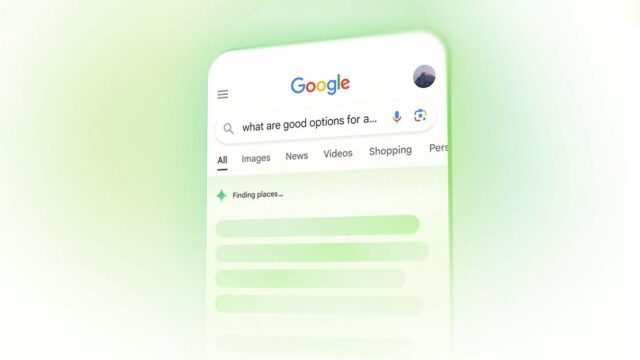
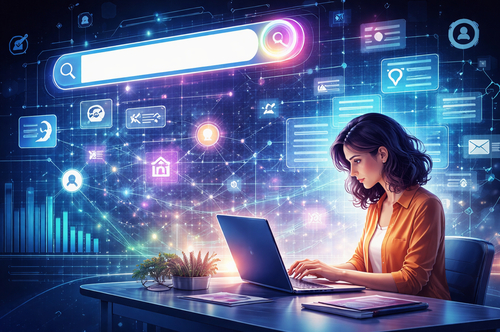
Google AI Overviews interface showing how AI generates direct answers without requiring the user to visit external websites.
If the panic were merely emotional, we could ignore it. But the numbers speak for themselves. Publishers worldwide are reporting dramatic drops in organic traffic. It's not a matter of "poor SEO." It's a matter of Google changing the rules of the game.
The following table summarizes the situation of some of the world's largest publishers in 2025:
| Publisher | Decline in organic traffic (2025) | Main cause identified |
|---|---|---|
| Buzzfeed | -75% | ai overviews and zero-click searches |
| The Guardian (UK) | -57% | reduction of visible results |
| Forbes | -50% | content synthesized by AI |
| Business Insider | -44% | Direct answers in SERP |
| NBC News | -42% | less space for organic links |
| HuffPost | -41% | prioritization of AI overviews |
| Daily Mail | -38% | decrease in clicks on results |
| CNN | -32% | fragmentation of user attention |
| Mail online (US) | -32% | changes to Google's algorithm |
| Washington Post | -30% | competition with AI responses |
| Quora | -26% | AI-generated content in SERPs |
| FOX News | -24% | organic visibility reduction |
| New York Post | -20% | fewer results per page |
| BBC (US) | -16% | content geolocation AI |
| USA Today | -15% | preference for quick answers |
| New York Times | -5% | partially resilient subscription model |
| People.com | +28% | entertainment content with high direct engagement |
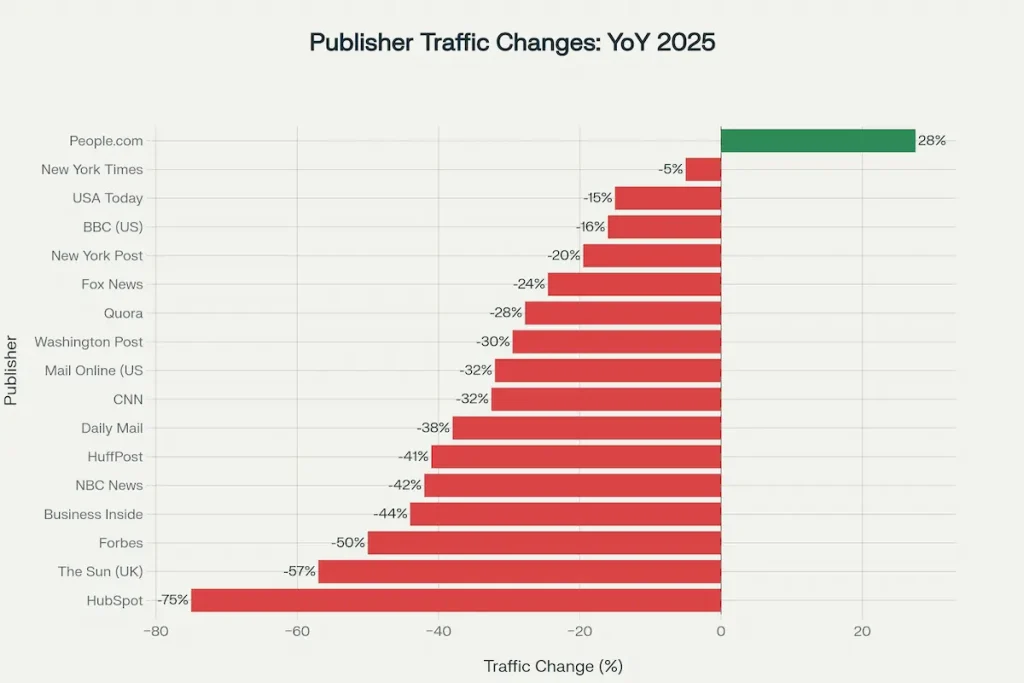
Chart showing changes in publisher traffic during 2025, with significant declines in most traditional media. Source: The Digital Bloom - 2025 Organic Traffic Crisis Analysis Report.
These numbers aren't theories. They're real reports from companies that invest millions in content and suddenly see their main source of visitors evaporate. BuzzFeed's case, with a 75% drop, is especially alarming because it represents a generation of digital media outlets that were born and raised on Google's organic traffic model.
It's easy to blame Google. But understanding its motives is key to anticipating the future. Google isn't a charity indexing the web. It's a company that lives off advertising. And advertising works best the more time you spend on its platforms.
When Google gives you the answer directly, you stay on Google. And while you're there, you see ads. Those ads are from Google, not the websites that originally created the content. It's a brilliant business model for Google and devastating for those who rely on third-party traffic.
Moreover, the competition never rests. ChatGPT, Perplexity, Claude, and other conversational search engines are gaining ground. Google can't afford to fall behind by offering only a list of links. It has to evolve toward conversation, toward immediate responses, toward the experience users demand. And that user demand is real: most people prefer a quick answer to having to navigate through five different sites.
The problem is that this evolution comes at a cost. And that cost is borne by content creators, small businesses, bloggers, independent media outlets, and anyone who built their digital strategy on the premise that Google would send traffic in exchange for quality content.
This is where we need to separate the drama from the reality. No, the domains aren't going to disappear. But they will change their function.
A domain is still necessary for:
- E-commerce (AI cannot process your payment or send you a physical product).
- Professional services (you need a page where you can hire, schedule, and pay).
- Communities and memberships (private spaces that AI cannot replicate).
- Personal and corporate branding (your domain is your digital identity).
- Interactive experiences (tools, calculators, simulators).
What is dying, or at least mutating drastically, is the "purely informative content website" model that lives exclusively off organic Google traffic. If your business is creating "how-to" articles and monetizing them with AdSense or Amazon affiliate ads, you're in a high-risk zone.
Google's AI can synthesize that information better, faster, and without the user having to visit your page. Your content becomes raw material for the AI, not the destination for the user.
If traditional SEO is losing its edge, what's replacing it? This is where new disciplines come in that every digital professional should be familiar with:
- SEO (Search Engine Optimization): It remains relevant, but it's no longer enough. Optimizing for Google still matters, but only for searches where AI doesn't provide a complete answer.
- AEO (Answer Engine Optimization): This is the optimization process that ensures AI cites you as a source when generating answers. The goal isn't for the user to click, but rather for the AI to mention you.
- GEO (Generative Engine Optimization): It goes further. It's about structuring your content so that language models (LLMS) understand it, value it, and incorporate it into their generative responses.
- LLMS (Large Language Models): These are the brains behind it all. Understanding how they work, what data they consume, and how they decide which sources to cite is the new frontier of digital visibility.
The transition isn't from SEO to nothing. It's from SEO to SEO + AEO + GEO. It's a more complex ecosystem, where having good keywords and backlinks is no longer enough. You need structured data, authoritative content, a presence across multiple formats, and a strategy that considers AI as an intermediary, not just the human as the end user.
One of the strongest criticisms of this model is the lack of compensation. Google uses content from millions of websites to train and feed its AI, but doesn't pay the creators for that use. It's like a restaurant using ingredients from all the local farmers to cook, selling the meals, and never paying them.
Some large publishers, like The New York Times, are negotiating direct deals with Google and OpenAI. But small creators, bloggers, niche sites, and local entrepreneurs have no bargaining power. Their content is absorbed by AI and their traffic dwindles, without any compensation.
This raises serious questions about the future of content creation. If no one can monetize the information they produce, who will continue to produce it? AI needs fresh, high-quality data to remain useful. If it kills its sources, it will eventually run out of new content to synthesize. It's a vicious cycle that, in the long run, could even harm Google.
Panic solves nothing. Adaptation does. Here are some concrete strategies for surviving and thriving in this new scenario:
1. Diversify traffic sources . Relying exclusively on Google is a fatal risk. Social media, email marketing, private communities, podcasts, YouTube, TikTok—all are channels that Google doesn't control.
2. Create content that AI cannot replicate. Personal opinions, lived experiences, interviews, original research, exclusive data, interactive tools. AI synthesizes, but it doesn't live.
3. Build a community, not just an audience. An Instagram follower can disappear with an algorithm change. A member of your private community cannot. The value lies in the relationship, not the visit.
4. Optimize for AEO and GEO. Structure your content so that AI will cite you. Use structured data, answer questions directly, and build subject authority.
5. Think in terms of transactions, not just information. If your website does something AI can't (sell, schedule, interact, personalize), you're still relevant.
6. Monetize directly . Subscriptions, digital products, services, consulting. Less reliance on ads and more reliance on real value delivered.
From my perspective, this article is neither alarmist nor complacent. The reality is that we are in the midst of a painful but necessary transition. For two decades, the internet operated under a model that benefited Google and those who knew how to play by its rules. That model is breaking down, and that's not necessarily a bad thing.
What is truly worrying is the concentration of power. If Google, Microsoft, and OpenAI become the sole intermediaries between information and the user, we lose diversity, plurality, and the ability to discover new voices. The risk isn't that domains will die out. The risk is that the internet will become a monopoly of three companies that decide what we know, how we know it, and whose opinions we trust.
My practical suggestion: don't abandon your website. But don't treat it as your only digital asset either. Build an ecosystem where your domain is the center, but not the only point of contact. Use AI to your advantage, learn how it works, and position yourself as an authoritative source in your niche. The future doesn't belong to those with the most traffic. It belongs to those with the most trust.
Domains aren't going to die. Nor are websites. But the business model that made them valuable for twenty years is in intensive care. Google isn't going to back down from its commitment to AI. The question isn't whether this will happen, it's how we adapt.
For businesses, this means rethinking digital strategies that were valid five years ago but are now obsolete. For creators, it means finding new ways to monetize their knowledge. For users, it means immediate convenience but also the risk of living in an information bubble controlled by algorithms.
The critique this article proposes is simple: change is real, the data confirms it, but catastrophe is optional. Those who adapt quickly and intelligently will not only survive, but could thrive in a more diverse, more human digital ecosystem, less dependent on a single search engine.
The future of domains doesn't depend on Google. It depends on us, doesn't it?
-
-
-
-
-
-
-
-
-Ars Technica. "Surprising no one, new research says AI Overviews cause massive drop in search clicks." July 2025. https://arstechnica.com/ai/2025/07/research-shows-google-ai-overviews-reduce-website-clicks-by-almost-half/
- The Digital Bloom. "2025 Organic Traffic Crisis: Zero-Click & AI Impact Report." 2025. https://thedigitalbloom.com/learn/2025-organic-traffic-crisis-analysis-report/
- SE Ranking. "How Does Social Media Traffic Compare to Organic and AI in 2025?". 2025. https://seranking.com/blog/social-media-traffic-research-study/
- Moving Traffic Media. "Resolving and Diagnosing SEO Traffic Drops: A Comprehensive Guide." 2025. https://www.movingtrafficmedia.com/resolving-diagnosing-seo-traffic-drops-guide/
- Vecteezy. "AI Powered Search Results Concept." Vector illustration. https://www.vecteezy.com/vector-art/57131162-ai-powered-search-results-concept
If «Google, AI, and the future of domains: a critical look at the change no one asked for» leaves the thread open, the natural next reads are «The .com, .org, and .net domain business: a monopoly disguised as a public service» and «Geo and aeo: the future of search beyond traditional keywords». la invitación necesita URL estable; AEO cita dominios, no screenshots. On TuRSVP that lands in «NULL».
Enviando comentario…
 EmiteDocs
Diplomas en lote: 3/semana gratis, hasta 1000 por $500. Contratos: desde $199, hasta 100.
EmiteDocs
Diplomas en lote: 3/semana gratis, hasta 1000 por $500. Contratos: desde $199, hasta 100.
 CrearPlantillas
Editor visual. 2 gratis/mes, 5/semana con cuenta, o 20 descargas por $69 MXN.
CrearPlantillas
Editor visual. 2 gratis/mes, 5/semana con cuenta, o 20 descargas por $69 MXN.
 TuRSVP
Invitaciones con RSVP. Desde $299 MXN, pago único.
TuRSVP
Invitaciones con RSVP. Desde $299 MXN, pago único.
 Minitareas
Tableros con Google. Libre: 1 tablero. Pro: $249 MXN al mes.
Minitareas
Tableros con Google. Libre: 1 tablero. Pro: $249 MXN al mes.
 Cotización de páginas web
Arma tu sitio por módulos y cotiza en MXN. Usarlo no tiene costo.
Cotización de páginas web
Arma tu sitio por módulos y cotiza en MXN. Usarlo no tiene costo.
 Convertidor de formatos
Convierte Excel, Word, PDF e imágenes. $150 MXN al mes, hasta 200.
Convertidor de formatos
Convierte Excel, Word, PDF e imágenes. $150 MXN al mes, hasta 200.
 Monitor Global
Clima, sismos, huracanes y tsunamis. Consulta gratis.
Monitor Global
Clima, sismos, huracanes y tsunamis. Consulta gratis.
 Promo a la vista
Catálogo gratis. Resumen gratis o desde $200/mes. Comida destacada: $500/mes.
Promo a la vista
Catálogo gratis. Resumen gratis o desde $200/mes. Comida destacada: $500/mes.
 Ravicom
Restaurantes y platillos. Buscar y registrar es gratis.
Ravicom
Restaurantes y platillos. Buscar y registrar es gratis.


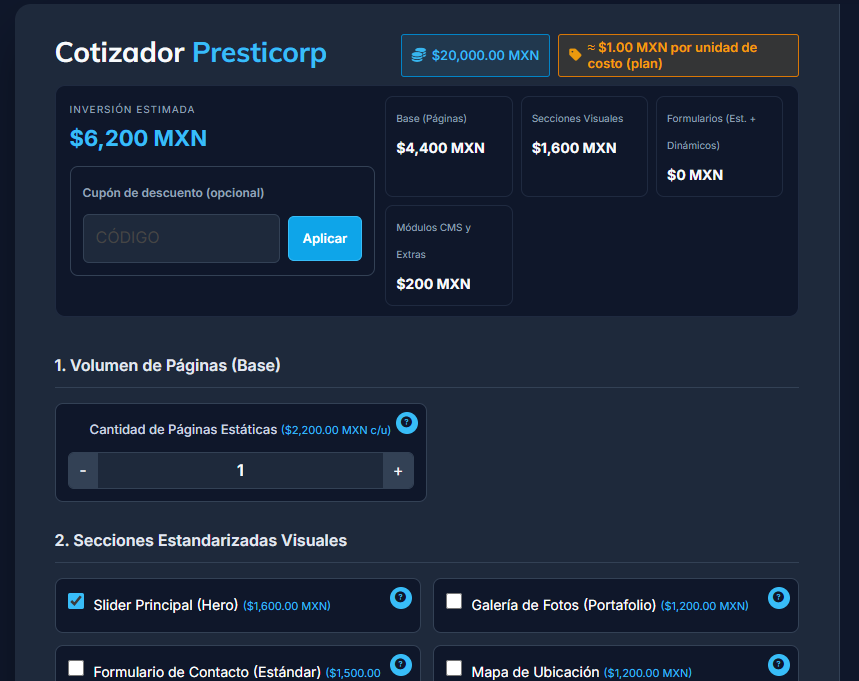
Si tu proyecto requiere una solución más enfocada, entra directo a la landing ideal para tu negocio y envíanos tu información en el formulario correspondiente.
Ofertas vigentes del catálogo, de la más nueva a la más antigua.
Ver promociones Tenis Under Armour HOVR Infinite MVMNT unisex gris (−55%)
Tenis casuales Under Armour HOVR Infinite MVMNT unisex, modelo 3028667-024, color gris
Tenis Under Armour HOVR Infinite MVMNT unisex gris (−55%)
Tenis casuales Under Armour HOVR Infinite MVMNT unisex, modelo 3028667-024, color gris
 Cupón OpenAI: ChatGPT Go gratis 1 mes con Rappi (3 meses con Rappi Pro, 6 con Pro Black; hasta 31 dic 2026)
Suscripción gratuita a ChatGPT Go de OpenAI (1, 3 o 6 meses) para usuarios de Rappi en México
Cupón OpenAI: ChatGPT Go gratis 1 mes con Rappi (3 meses con Rappi Pro, 6 con Pro Black; hasta 31 dic 2026)
Suscripción gratuita a ChatGPT Go de OpenAI (1, 3 o 6 meses) para usuarios de Rappi en México
 Cupón Claude: −50% uso al crear/editar artefactos (sin código, hasta 15 oct 2026 23:59 PT)
Promoción temporal de Anthropic: 50% menos uso del límite de sesión de 5 h al crear o editar artefactos en Claude
Cupón Claude: −50% uso al crear/editar artefactos (sin código, hasta 15 oct 2026 23:59 PT)
Promoción temporal de Anthropic: 50% menos uso del límite de sesión de 5 h al crear o editar artefactos en Claude









0 Comentarios