










The business of .com, .org, and .net domains is not just a story of digital infrastructure; it is a case study of how natural monopolies can become rent-seeking machines when public regulation fails or, worse, when it aligns with the monopolist's interests.
The question we should be asking isn't whether paying twelve or fifteen dollars a year for a domain is expensive. The question is: why are we paying more and more for a service whose technical cost has steadily decreased, and why does a single company control access to more than 70 percent of generic names on the internet?
The first .com domain in history, symbolics.com, was registered on March 15, 1985, in an academic context where no one imagined the commercial value of a web address. During the first half of the 1990s, registration was controlled by Network Solutions, the only provider authorized by the National Science Foundation, which charged up to one hundred dollars per domain and required a minimum two-year commitment. In 1998, under antitrust pressure, the United States government created the Internet Corporation for Assigned Names and Numbers (ICANN) to introduce competition and reduce prices. The separation between the registry (the database that operates the extension) and the registrar (the store that sells to the public) caused the wholesale price to fall to six dollars, democratizing access to the web.
However, what began as a pro-competition reform degenerated into a system where regulatory revenue replaced genuine competition. Network Solutions was acquired by Verisign in 2000 for twenty-one billion dollars, and since then, the .com and .net domain registrations have remained under its exclusive control. Far from fostering openness, ICANN signed contracts allowing for scheduled annual increases, eliminated price caps on key extensions like .org, and received direct payments from Verisign in exchange for approving fee hikes. In other words, the agency created to protect consumers became a financial partner of the monopolist.
Verisign is probably the most profitable company in the United States, yet very few consumers know its name. In 2023, its pre-tax operating margin reached 65.4 percent, a figure that surpasses tech giants and investment banks. Its secret isn't innovation or operational efficiency, but a government contract that grants it the exclusive right to charge 172 million websites an annual fee for maintaining a database that, technically, could be managed for less than a dollar per domain per year.
The business logic is simple and brutal. Verisign doesn't sell a product that the customer can replace. If you want a .com, there's no alternative. If your company's brand has already built recognition under that extension, switching to .net or .shop means losing direct traffic, user trust, and search engine ranking. This path dependency makes domains an inelastic commodity: the price can rise, but demand barely moves. It's no different from a toll road with no alternative route; the concessionaire charges whatever they want because the user has nowhere else to go.
The current contract, inherited from the Trump administration and automatically renewed unless the National Telecommunications and Information Administration (NTIA) decides otherwise, allows Verisign to increase its wholesale rates by 7 percent annually in four out of every six years. From the initial price of six dollars in 2010, the price reached $10.26 in 2026, a cumulative increase of 70 percent. During the same period, the costs of maintaining the DNS system not only didn't increase, they actually decreased thanks to automation and economies of scale. The difference between the cost of providing the service and what is charged is not profit margin; it is pure monopoly rent, transferred from millions of small businesses, nonprofits, and entrepreneurs to Verisign shareholders, including Warren Buffett.
The following table summarizes the evolution of the wholesale price of the .com domain and its relationship with Verisign's margins.
Tab
| Period | Wholesale price .com (USD) | Verisign operating margin | Key regulatory event |
|---|---|---|---|
| 2000-2006 | 6.00 | Not publicly available | Post-ICANN registry/registrar separation |
| 2007-2012 | 7.34 | Approximately 50 percent | Obama administration tariff freeze |
| 2013-2018 | 7.85 | 58.9 percent (2021) | Automatic renewal without price increases |
| 2019-2024 | 8.39 - 9.59 | 65.4 percent (2023) | 7 percent annual increase approved by Trump NTIA |
| 2025-2026 | 10.26 | 67.3 percent (est.) | Maximum price under current contract |
Source: Prepared by the author using data from Namecheap, Domain Incite and GuruFocus.
Perhaps the most objectionable aspect of the domain name business is not the monopoly itself, but the incentive structure that perpetuates it. ICANN was conceived as the guardian of the public interest in internet governance. In practice, it is financially dependent on the very companies it is supposed to regulate. Verisign pays ICANN an additional twenty million dollars in a side agreement, plus twenty-five cents per domain registered each quarter. When the latest price increase for .com was approved in 2020, the agreement explicitly included this payment, as if it were a commission for facilitating the price hike.
Organizations like the American Economic Liberties Project have described this relationship as a de facto cartel, an incestuous triangle between Verisign, ICANN, and the U.S. Department of Commerce that blocks antitrust scrutiny. The logic is perverse: ICANN doesn't set prices because it claims to defer to competition authorities; competition authorities don't intervene because ICANN is a private, non-profit entity; and Verisign raises prices because both entities provide it with legal cover. The end user, who foots the bill, has no say in any of the three.
The case of .org domains further illustrates this trend. Until 2019, the Public Interest Registry (PIR), a non-profit operator, managed the extension with reasonable price caps. ICANN eliminated these caps despite receiving over 3,500 public comments, 98 percent of which opposed the measure. Shortly thereafter, the PIR was sold to a private equity firm (Ethos Capital) with financial leverage, transforming a public-benefit infrastructure into a debt asset. Non-profit organizations that rely on .org for their digital presence went from being beneficiaries to captive clients of an investment fund.
The domain name business is not just economic; it's geopolitical. Control of .com and .net, managed by a US company under contract with a US government agency, means that Washington retains considerable leverage over much of the internet's identity infrastructure. Although ICANN promotes a multi-stakeholder model, the reality is that key decisions about pricing, contracts, and new extensions are made in closed circles where the voice of end users is merely symbolic.
The inevitable question is whether this model is sustainable. The emergence of hundreds of new generic extensions (.xyz, .online, .tech) was presented as the competition that would break the monopoly. The reality is different. Legacy domains (.com, .net, .org) concentrate user trust, direct traffic, and brand equity accumulated over decades. A .com site is still perceived as more professional and reliable than a .store or .io site, even though technically there is no difference. This perception, rooted in the early history of the web, makes the new extensions marginal complements, not true replacements.
Furthermore, Verisign has demonstrated an ability to neutralize competitive threats. In 2016, when ICANN auctioned the .web extension, an unknown buyer paid $135 million. Three days later, it was revealed that Verisign had financed the transaction, effectively acquiring one of the few viable alternatives to .com. The Department of Justice investigated but closed the case in 2018. Today, .web remains largely unused, which likely suited Verisign from the start.
Where are we headed? The current contract between Verisign and the NTIA is automatically renewed every six years unless the agency provides months' notice. The next window of opportunity to open the .com domain to competitive bidding or restore reasonable price caps is approaching. However, recent history is not encouraging: price increases were approved behind the community's back, public comments were dismissed as spam, and kickbacks to ICANN institutionalized the regulatory commission.
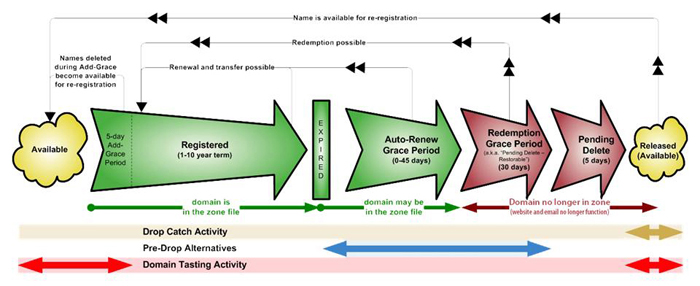
Official ICANN diagram illustrating the registration, grace, redemption, and release phases of a generic domain. Source: ICANN.org.
My position is that the legacy domain business represents one of the most glaring failures of internet governance. This isn't about demonizing Verisign, which operates within the legal framework it was given. It's about pointing out that this legal framework is the problem. A domain name system is, in essence, a distributed database with near-zero marginal costs. Turning it into a source of 65 percent monopoly rent has no economic or technical justification; it has political justification, based on regulatory capture and government inaction.
The analogy with digital real estate, so often used in marketing, is misleading. Physical land is scarce; domain names are not. The scarcity of .com domains is artificial, created by the political decision not to open the extension to competitive operators. If .com were auctioned off every five years among multiple registries, as happened with .net in 2011, prices would fall dramatically and the quality of service would improve. That was precisely the model that ICANN promoted for new extensions, but refused to apply to legacy domains for fear of disrupting established interests.
The criticism doesn't imply that domains should be free. There are real costs associated with infrastructure, security, and dispute resolution. But those costs don't justify ten dollars per year per domain when competitors have publicly stated they could operate the registry for less than one. The difference isn't efficiency; it's extraction.
For entrepreneurs and small businesses, especially in emerging markets, every price increase is a barrier to entry. For nonprofits, it's budgetary uncertainty that diverts resources from their mission. For digital innovation in general, it's an invisible tax that burdens the creation of a web presence without generating equivalent technical compensation.
![What is Domain Registration - [Infographics]](https://kimi-web-img.moonshot.cn/img/imgfile.serversea.com/4c0e23b81dd11db9b61b6eadc8059e8a94d6fc88.png)
Infographic summarizing the essential elements of domain registration: SSL security, choosing an extension, brand significance, and purchase steps. Source: Serversea.pk.
From my experience helping companies build their digital presence, I've noticed that many entrepreneurs underestimate the strategic importance of domain names in their business plan. It's not just about choosing a nice name; it's about understanding that you're renting an address on a highway where the concessionaire can raise the toll without consulting you. My practical recommendation is to diversify: if your brand allows it, register the .com version simultaneously with at least one alternative extension (.mx, .co, .io, or a relevant new gTLD). Not because you'll use them all, but because having them gives you future negotiating power and brand protection.
Second, read the fine print of the registrars. The first-year price is marketing; the renewal price is the business. Some registrars offer domains for free the first year and triple the fee upon renewal. Always compare the cost over ten years, not just the first year.
Third, activate privacy protection. Registering a domain exposes your name, address, and phone number in public databases accessible to any scraper. Privacy isn't a luxury; it's a basic security measure against spam, phishing, and social engineering.
Finally, don't idealize the .com domain. If your market is local, a country code top-level domain (.mx, .es, .ar) can provide better local ranking and lower costs. If your audience is young or tech-savvy, extensions like .app or .dev can better communicate your value proposition. The .com domain is the default option, but not always the best.
Schedule an appointment with Presticorp and receive personalized advice on choosing the ideal domain for your business, protecting your brand across multiple extensions, and planning long-term renewals without price surprises. Our specialists will help you make an informed decision, not a panicked one.
The business of .com, .org, and .net domains is a reminder that the internet doesn't self-regulate through technical means. It requires institutions that genuinely represent the user and aren't funded by monopoly profits. The upcoming review of the Verisign-NTIA contract, scheduled for the next few years, will be a litmus test. If the US administration decides not to renew and opens .com to competitive bidding, we could see a price reduction similar to what happened with .net in 2011, when the price fell from six dollars to three dollars and fifty cents.
If, on the other hand, the status quo is maintained, we will continue to pay an unjustified digital tax to a company that doesn't compete, doesn't innovate, and doesn't need to because the state guarantees its monopoly. For millions of businesses in Latin America and the rest of the world, this decision made in Washington translates into real costs, barriers to digitalization, and a lesson in how technical governance, when disconnected from the public interest, becomes a closed business.
Your company deserves a solid digital strategy from the ground up. Schedule an appointment with Presticorp today and let's build a web presence together that grows without relying on third-party monopolies. We look forward to hearing from you.
-
-
-
-
-
-
-
-
-
-
-
Doominio. (2026, January 13). The surprising history of domain registration and its prices.https://www.doominio.com/blog/que-es-un-dominio
Economic Liberties Project. (2024, July 24). A call for .com-petition: Reining in Verisign's monopoly over the internet's most popular top-level domain. https://www.economicliberties.us/our-work/a-call-for-com-petition-reining-in-verisigns-monopoly-over-the-internets-most-popular-top-level-domain/
Domain Incite. (2020, January 3). Verisign pays ICANN $20 million and gets to raise .com prices again. https://domainincite.com/25129-breaking-verisign-pays-icann-20-million-and-gets-to-raise-com-prices-again
IPTWINS. (2025, November 6). Forty years of DNS: From symbolics.com to the dawn of the 2026 round. https://iptwins.com/2025/11/06/forty-years-of-dns-from-symbolics-com-to-the-dawn-of-the-2026-round/
Mashable. (2019, August 9). How the battle over domain prices could drastically change the web. https://mashable.com/article/domain-name-price-caps-icann
Namecheap Blog. (2020, February 10). ICANN allows .com price increases, gets more money. https://www.namecheap.com/blog/icann-allows-com-price-increases-gets-more-money/
Prospect. (2024, June 27). The government created the most profitable company in America. https://prospect.org/2024/06/27/2024-06-27-government-created-most-profitable-company-verisign/
Shopify. (May 17, 2026). How much does a domain cost? Pricing guide. https://www.shopify.com/es/blog/cuanto-questa-dominio
If «The .com, .org, and .net domain business: a monopoly disguised as a public service» leaves the thread open, the natural next reads are «NULL» and «Google, AI, and the future of domains: a critical look at the change no one asked for». el dominio sigue siendo el ancla de la web de evento aunque la IA busque. On TuRSVP that lands in «NULL».

La neta el artículo le pega donde duele. Verisign con margen de más del 65 por ciento cobrando 10.26 dólares mayorista, y el DNS se podría operar por menos de un dólar. No es innovación, es peaje. Si tu marca ya está en .com, no te puedes salir. Eso es monopolio, aunque ICANN se vista de ong.
Héctor, simón. El punto no es si 12 dólares es caro para un wey de Madrid. Es que no hay carretera de al lado. Cambiar a .shop o .io es perder tráfico de gente que teclea la marca más .com. Por eso suben 7 por ciento y la demanda ni se inmuta.
Y lo de .org está peor, Héctor. Quitaron los topes con más de 3500 comentarios en contra, el 98 por ciento. Luego vendieron el registro a un fondo. Las ong pasamos de “esto es infraestructura de bien común” a cliente cautivo. A mí sí me duele en el presupuesto anual.
Héctor, alguien tiene que operar 172 millones de nombres sin que se caiga el DNS. Verisign cobra caro, vale, pero es infraestructura crítica, no una app. Compararlo con “menos de un dólar” suena a cuenta de servilleta. Yo prefiero pagar de más y que resuelva a las tres de la mañana.
Rogelio, si el .com te tiene amarrado, registra también el .mx y ya. El mismo texto lo recomienda. Para cliente en Guadalajara el .mx hasta posiciona mejor. No hay que hacer drama geopolítico por 10 dólares mayoristas.
Rogelio, en España la pyme local va de .es y nadie se pierde. El “todo el mundo escribe .com” es un mito de los 2000. Mis clientes buscan el nombre en Google, no teclean la url. El lock-in que pintan está inflado.
Sofía, lo de Ethos y el .org sí se ve feo, no lo niego. Pero mi .org sigue resolviendo y no me han vuelto loca la tarifa de un año para otro. Una venta de registro no convierte automáticamente cada ong en rehén. Hay tramo de exageración.
Iñigo, si fueran tan competitivos no habrían financiado la subasta de .web por 135 millones para guardársela. Tambien el Departamento de Justicia abrió y cerró. Eso no es “operar el DNS”, es comprar al vecino para que no abra carretera.
Héctor, que Buffett esté en el accionariado no vuelve esto una película de villanos. Es un negocio con contrato. Si la NTIA no lo abre a licitación, culpa de Washington, no de que el DNS sea “malvado”. Hay que bajarle dos rayitas al manifiesto.
Iñigo, el propio texto dice que en 2011 el .net bajó de 6 a 3.50 cuando sí hubo licitación. O sea, cuando hay competencia el precio cae y el internet no se acaba. El “es crítico por eso es caro” no se sostiene.
Iñigo, ICANN cobra 20 millones extra más 25 centavos por dominio al trimestre. El árbitro se financia con el peaje. Por eso los comentarios públicos los tratan como ruido. No es que “alguien tiene que operarlo”, es que el portero cobra comisión por abrir.
Iñigo, el uptime está bien, nadie pide que se caiga. El tema es que el contrato deja subir 7 por ciento con costos a la baja. Si el servicio es tan bueno, que compita en una licitación como el .net. Si gana, perfecto. Si no se presenta, ya vimos por qué.
Sofía, para ong mexicana el .org nunca fue tan barato como el .mx institucional. Yo les digo que se vayan a extensión de país y dejen de pelearle a un fondo en Virginia. Es más práctico que esperar a que Washington se conmueva.
Oye, que 12 o 15 dólares al año es un menú del día. El tono de “máquina de extraer rentas” se me hace muy de manifiesto. El .com funciona, no se cae, y yo llevo el de mi estudio desde 2012 sin drama. Si mañana pasa a 16, sigo pagando. Hay problemas de verdad en internet.
Marta, el precio de vitrina no es el negocio. El primer año te lo dejan casi en cero y al renovar te lo triplican. En dolares se ve poquito, a 10 años ya no. El artículo lo dice claro: compara la década, no el cupón. Eso me pasó con dos tiendas.
Marta, nadie dice que te arruine el menú. El rollo es el 70 por ciento de los genéricos en una sola empresa, subidas de 7 por ciento en cuatro de cada seis años, y el costo técnico bajando. De 6 dólares a 10.26 no es inflación del café, es renta.
Marta, 15 dólares para un estudio en Valencia no es lo mismo que para una asociación en Puebla que renueva 12 dominios. Y .org era el refugio barato. Cuando le quitan el tope, el “es un café” se cae. El usuario chico no está en esa mesa.
Karla, si el registrador te engaña con el año uno, cambia de tienda. Eso es el mostrador, no Verisign. Mezclar al mayorista con el que te vende el cupón de 99 centavos me parece un lío. Son dos capas distintas.
Héctor, lo de Trump, la NTIA y Buffett me queda lejísimos. Yo veo la factura de mi registrador y punto. Si el 7 por ciento llega, lo pago. Convertir eso en “impuesto digital a Latinoamérica” se me hace un salto. En mi pueblo el cuello de botella es otro.
Karla, la neta: yo ya pido cotización a 10 años. El 0 pesos el primer año es anzuelo. Y aunque cambies de registrador, el mayorista sigue siendo el mismo. Por eso el cupón no rompe el monopolio. Solo te cambia el mostrador.
Luis, registrar el .mx está bien, yo también lo hago. Pero no sustituye el .com si ya invertiste 8 años de marca ahí. Es parche, no competencia. El artículo habla de path dependence, no de que no existan otras extensiones.
Marta, Google te salva si te buscan por marca. No te salva al tipo que te escribe la url de memoria o al correo de la empresa en .com. Ese activo no se mueve a .store. Por eso el .com es inelástico. No es mito, es costumbre de 40 años.
Rogelio, que .web esté muerto también prueba lo otro: la gente no se pasa a extensiones nuevas. Entonces la “competencia” de .xyz y .tech era humo desde el día uno. Verisign no tuvo que matar un rival real. El usuario eligió .com.
Luis, el .mx es buena idea, el artículo también lo dice. El problema es llamarle “drama” a que una sola empresa se quedó con .com, .net y hasta metió mano en .web. Diversificar es defensa. No es lo mismo que el mercado sea justo.
Marta, las dos capas existen, de acuerdo. Pero el mostrador no pone el 65 por ciento de margen. Eso sale del registro exclusivo. Puedes elegir tienda. No puedes elegir quién opera el .com. Ahí se acaba el “cambia de tienda y ya”. El artículo no demoniza a Verisign; señala el contrato. Y el contrato es el problema.
Enviando comentario…
 EmiteDocs
Diplomas en lote: 3/semana gratis, hasta 1000 por $500. Contratos: desde $199, hasta 100.
EmiteDocs
Diplomas en lote: 3/semana gratis, hasta 1000 por $500. Contratos: desde $199, hasta 100.
 CrearPlantillas
Editor visual. 2 gratis/mes, 5/semana con cuenta, o 20 descargas por $69 MXN.
CrearPlantillas
Editor visual. 2 gratis/mes, 5/semana con cuenta, o 20 descargas por $69 MXN.
 TuRSVP
Invitaciones con RSVP. Desde $299 MXN, pago único.
TuRSVP
Invitaciones con RSVP. Desde $299 MXN, pago único.
 Minitareas
Tableros con Google. Libre: 1 tablero. Pro: $249 MXN al mes.
Minitareas
Tableros con Google. Libre: 1 tablero. Pro: $249 MXN al mes.
 Cotización de páginas web
Arma tu sitio por módulos y cotiza en MXN. Usarlo no tiene costo.
Cotización de páginas web
Arma tu sitio por módulos y cotiza en MXN. Usarlo no tiene costo.
 Convertidor de formatos
Convierte Excel, Word, PDF e imágenes. $150 MXN al mes, hasta 200.
Convertidor de formatos
Convierte Excel, Word, PDF e imágenes. $150 MXN al mes, hasta 200.
 Monitor Global
Clima, sismos, huracanes y tsunamis. Consulta gratis.
Monitor Global
Clima, sismos, huracanes y tsunamis. Consulta gratis.
 Promo a la vista
Catálogo gratis. Resumen gratis o desde $200/mes. Comida destacada: $500/mes.
Promo a la vista
Catálogo gratis. Resumen gratis o desde $200/mes. Comida destacada: $500/mes.
 Ravicom
Restaurantes y platillos. Buscar y registrar es gratis.
Ravicom
Restaurantes y platillos. Buscar y registrar es gratis.



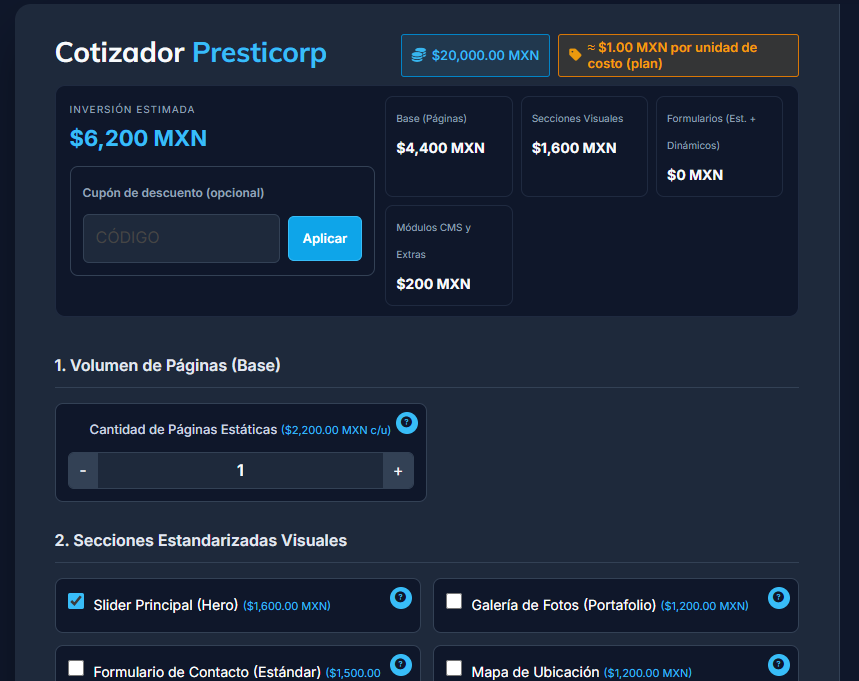
Si tu proyecto requiere una solución más enfocada, entra directo a la landing ideal para tu negocio y envíanos tu información en el formulario correspondiente.
Ofertas vigentes del catálogo, de la más nueva a la más antigua.
Ver promociones SaaS Alegra Facturación Pro: facturación electrónica CFDI en la nube −25% ($337/mes en plan anual)
Suscripción SaaS Alegra Facturación plan Pro (facturación electrónica CFDI ilimitada en la nube, 2 usuarios, compras y gastos, buzón CFDI, IA)
SaaS Alegra Facturación Pro: facturación electrónica CFDI en la nube −25% ($337/mes en plan anual)
Suscripción SaaS Alegra Facturación plan Pro (facturación electrónica CFDI ilimitada en la nube, 2 usuarios, compras y gastos, buzón CFDI, IA)
 Jeans Levi's 724 High-Rise Straight para mujer, azul (−60%)
Jeans Levi's 724 High-Rise Straight para mujer, tiro alto y pierna recta, color azul (modelo 18883-0304)
Jeans Levi's 724 High-Rise Straight para mujer, azul (−60%)
Jeans Levi's 724 High-Rise Straight para mujer, tiro alto y pierna recta, color azul (modelo 18883-0304)
 Bicicleta eléctrica plegable Honey Whale S4 blanca 350W, 25 km/h (−53%)
Bicicleta eléctrica plegable Honey Whale S4 Blanco, motor 350W, batería 36V/6Ah, llantas de 14 pulgadas
Bicicleta eléctrica plegable Honey Whale S4 blanca 350W, 25 km/h (−53%)
Bicicleta eléctrica plegable Honey Whale S4 Blanco, motor 350W, batería 36V/6Ah, llantas de 14 pulgadas
 Patín eléctrico (scooter) Bikeon G5 doble motor 800W, 45 km/h (−37%)
Patín eléctrico / scooter eléctrico Bikeon G5 modelo 2026, motor dual 800W, batería de litio 48V 16Ah
Patín eléctrico (scooter) Bikeon G5 doble motor 800W, 45 km/h (−37%)
Patín eléctrico / scooter eléctrico Bikeon G5 modelo 2026, motor dual 800W, batería de litio 48V 16Ah











25 Comentarios