











This article, the second part of our analysis of the evolution of prices in AI tools, examines how the main players in the market have redefined their subscription models over the past few months and what implications this has for individual developers and enterprise teams.
For much of 2025, the AI tools market for developers operated under a relatively simple model: subscription plans with unlimited access to basic functionalities and generous limits for advanced features. However, in early 2026, this structure began to unravel.
Cursor , which had already surpassed one billion dollars in annualized revenue, implemented a credit system based on actual token consumption. Its $20 monthly Pro plan includes $20 in usage credits, which are consumed according to the selected AI model and task complexity. A developer using Claude Sonnet intensively can exhaust these credits in approximately 225 requests, while using Gemini allows for around 550 requests.
GitHub Copilot, historically the most stable player in the market, also underwent significant changes. Starting in June 2026, the company explicitly began moving toward a usage-based billing model, where the price per seat no longer represents the entire budget. The Business and Enterprise plans now include additional premium request packages that must be purchased separately once the base limits are reached.
Google Antigravity, for its part, has maintained its controversial Ultra plan at $249 per month, but has introduced a system of supplemental credits that allows users to continue working after exhausting their weekly quotas. Each credit costs one cent, with volume pricing at $199 for 20,000 credits. Transparency regarding how many tokens or trades each credit buys, however, remains limited.
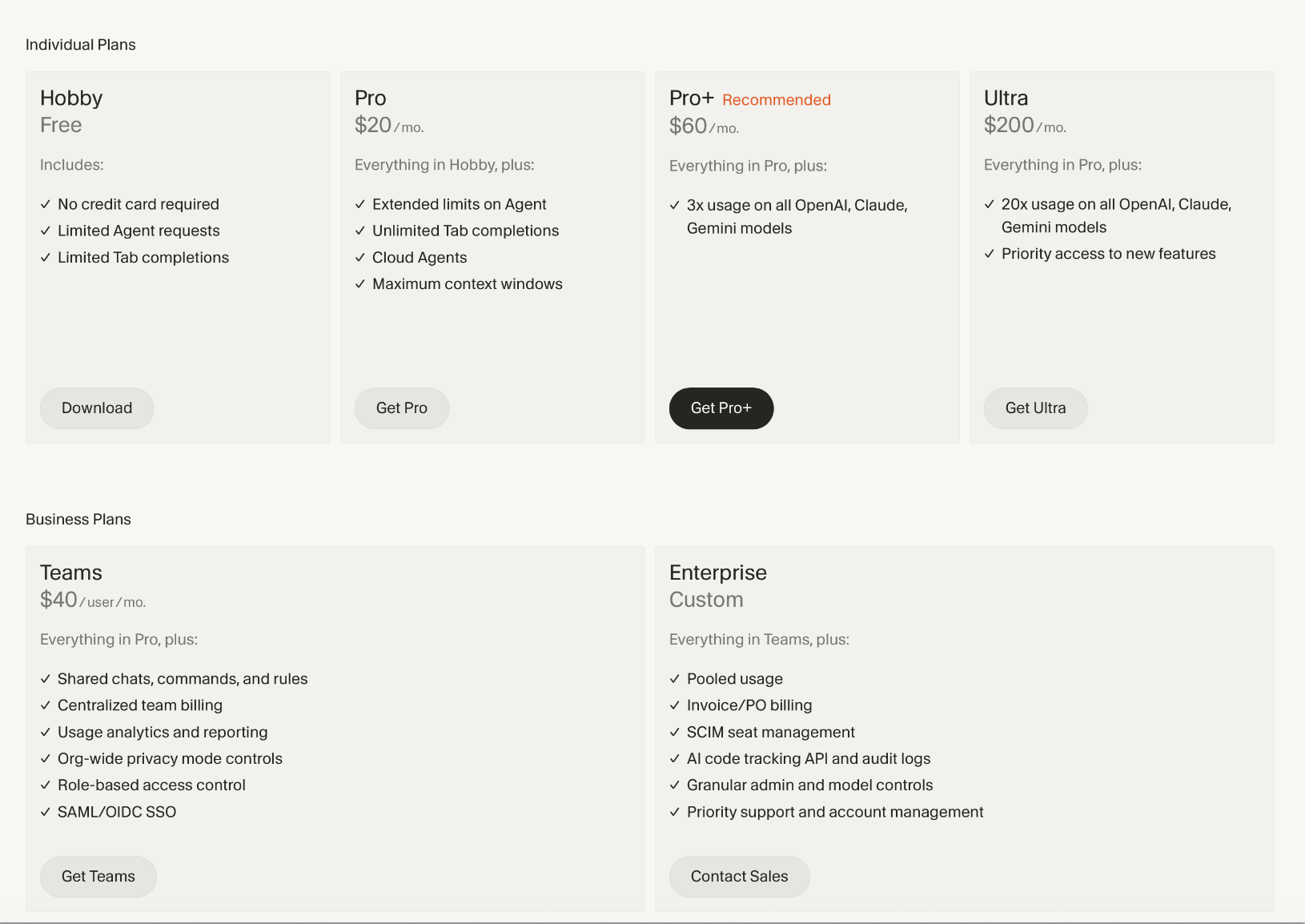
Cursor AI pricing plan structure in 2026, showing the transition from fixed subscriptions to credit-based models. Source: UI Bakery Blog.*
The current market presents three distinct approaches to monetizing AI tools for developers, each with its own specific advantages and disadvantages.
The subscription model with included credits
Cursor and GitHub Copilot exemplify this category. Users pay a fixed monthly fee that includes a pool of credits or premium requests. Once these are depleted, they can choose to upgrade their plan, purchase additional credits, or continue with limited functionality. This model offers partial predictability: users know their base cost, but total spending can vary depending on usage patterns.
The unlimited subscription model with hidden restrictions
Google Antigravity Ultra promises high-volume access with no weekly usage limit, but maintains undocumented restrictions on experimental models and image generation. The quota of twenty daily requests on the free plan, reduced from the original two hundred and fifty, represents a ninety-two percent decrease since its launch in November 2025. This model raises concerns because the limitations are only revealed after subscribing.
The open-source model with API costs
Tools like Aider, Continue, and OpenCode offer unlimited functionality but require the user to provide their own language model API keys. The actual cost depends on the chosen API provider, with budget-friendly options like DeepSeek enabling serious development for five to ten dollars per month. This model shifts the pricing complexity to the user but offers maximum flexibility.
| Tool | Pricing model | Base cost | Free limit | Main hidden cost | Transparency |
|---|---|---|---|---|---|
| Cursor Pro | Subscription + credits | $20 USD/month | Limited applications | Additional credits at API rate | Average |
| Ultra Cursor | Premium subscription | $200 USD/month | Not applicable | Additional Bugbot $40 USD/month | Low |
| GitHub Copilot Pro | Fixed subscription | $10 USD/month | 2K completions | Premium requests 3x cost | Average |
| GitHub Copilot Business | Subscription + use | $19 USD/user | Not applicable | Additional application packages | Medium-Low |
| Google Antigravity Pro | Fixed subscription | $20 USD/month | 20 applications/day | Credits at $0.01 USD each | Low |
| Google Antigravity Ultra | Premium subscription | $249.99 USD/month | Not applicable | Undocumented limits in experimental models | Very low |
| Claude Code | pure API | Variable | Not applicable | Cost per token consumed | High |
| Aider/Continue | Open Source + API | $0 | Unlimited | LLM API invoice | High |
| Codeium/Windsurf | Freemium | 0-15 USD/month | Unlimited completions base | Advanced payment features | Average |
The promises of unlimited subscriptions clash with reality when you analyze the effective cost per hour of development. A developer working four hours a day with AI agents will likely need the Cursor Pro+ plan at sixty dollars a month, or even the Ultra plan at two hundred dollars. For teams of five developers, this represents between one thousand and ten thousand dollars a month in AI tool licenses alone.
Feature-by-feature analysis reveals significant disparities. Tab autocompletion in Cursor is effectively unlimited across all paid plans, but agent requests, which represent the true differentiating value, are strictly limited. GitHub Copilot offers unlimited autocompletion in its ten-dollar Pro plan, but agent capabilities are restricted to 300 premium requests per month, with advanced models like Claude Opus consuming three requests per use.
The transition to usage-based pricing, while theoretically fairer, introduces budgetary unpredictability. Development teams must now monitor consumption dashboards in real time and set spending limits to avoid surprise bills. This administrative complexity represents an indirect cost that few organizations had previously considered.
Dissatisfaction with opaque pricing models has fueled the growth of open-source alternatives and hybrid setups. The ecosystem of free AI programming tools in 2026 is clearly divided into two camps: proprietary free plans with strict limitations and open-source tools that require custom API management.
The zero-dollar setup recommended by the developer community combines Continue in VS Code with Ollama running local models like DeepSeek-Coder. This solution requires decent hardware, preferably 16 gigabytes of RAM and a modern GPU, but completely eliminates subscription costs. The main limitations are speed on older hardware and difficulties with complex, multi-file changes.
The five-dollar-per-month setup uses OpenCode in the terminal with the DeepSeek API for large tasks, complemented by GitHub Copilot Free for inline completion. This combination covers most of an individual developer's needs at a fraction of the cost of Cursor Pro.
The transition point to paid tools typically occurs when API call expenses exceed fifteen to twenty dollars per month. At that point, a subscription with unlimited usage, faster autocomplete, and a polished user experience becomes economically justified.
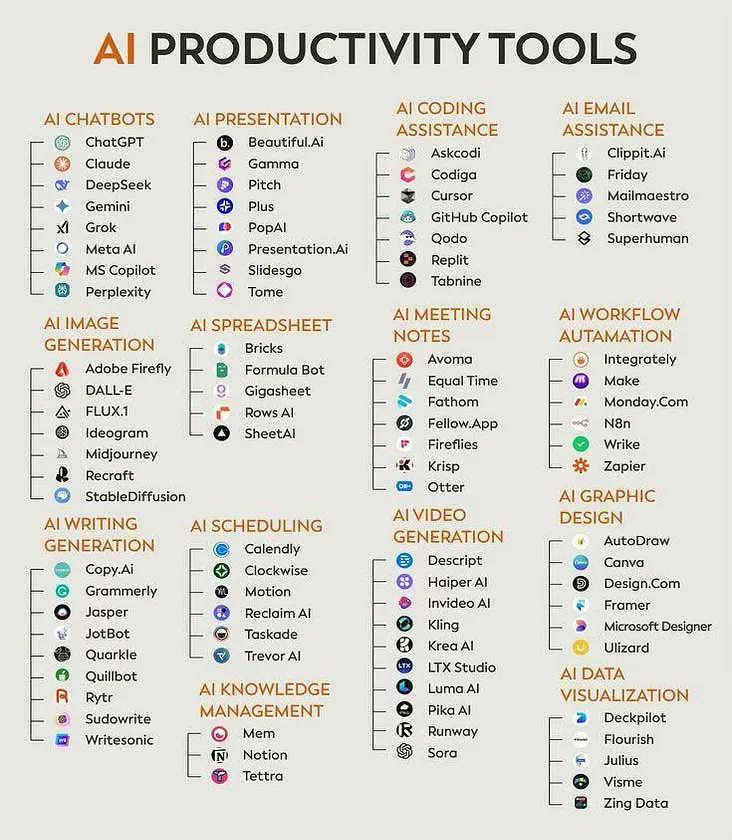
A comprehensive overview of AI-powered productivity tools in 2026, including coding assistants, chatbots, and content generation. Source: The AI Corner.*
Three major trends are reshaping the pricing market for AI tools for developers.
First , the commoditization of models is putting downward pressure on prices. DeepSeek, Mistral, and open-source models are making frontier models interchangeable. Tools that rely on proprietary models will be forced to lower prices or offer more model options.
Second , per-seat billing is giving way to per-use billing. Credits, tokens, and request limits are replacing rigid Pro plans. This makes pricing harder to compare but theoretically fairer for different usage levels.
Third , the enterprise tier is becoming the standard. Single sign-on, audit logs, and intellectual property indemnity features, which were premium in 2024, are now available at the team tier in almost all tools. The enterprise premium is shrinking.
After extensively analyzing the price evolution of AI tools for developers during 2026, my main recommendation is that developers and teams stop searching for the perfect unlimited subscription and adopt a portfolio management mindset.
The current market doesn't offer a truly unlimited solution at a reasonable price. Each vendor has deliberately built limits into their business models to maximize customer value over time. The right question isn't which tool offers more for less, but which combination of tools meets your specific needs at the lowest total cost.
For individual developers, I suggest starting with the open-source setup: Continue + Ollama with local models. This solution allows you to understand your actual consumption patterns without committing to a large budget. When you identify that you need agent capabilities or edge models, run a one-month trial of Cursor Pro or Claude Code, carefully monitoring credit usage.
For enterprise teams, the recommendation is more complex. GitHub Copilot Enterprise's intellectual property indemnity, which protects against claims for AI-generated code, alone justifies the cost of the $39 per seat plan for organizations with significant legal risk. However, smaller teams can obtain comparable value with combinations of open-source tools and selective subscriptions.
The real risk isn't the monthly cost of twenty or two hundred dollars. It's the increasing reliance on workflows that only work with specific tools, creating prohibitive switching costs. My final piece of advice: always maintain an escape route. Never let 100 percent of your workflow depend on a single AI platform, no matter how much it promises to be unlimited.
The transition from fixed subscription models to credit systems has transformed cost management in software development. What was once a predictable line item in the budget now requires constant monitoring, analysis of usage patterns, and tactical decisions about which AI model to use for each task.
At Presticorp, we help technology companies and development teams audit their AI tool spending, identify redundancies, and design licensing strategies that maximize return on investment. Our analysis includes real-world usage assessments, vendor comparisons, and negotiation models for enterprise plans.
Schedule a free audit with Presticorp and discover how much you could be saving on your AI tools while maintaining or improving your team's productivity. Book your appointment now and take control of your technology budget.
The market for AI tools for developers will continue to evolve rapidly during the second half of 2026. Developers who thrive will be those who master not only the technology but also the economics of their tools. The ability to optimize costs without sacrificing productivity is becoming as valuable a skill as programming itself.
Leading platforms will continue to adjust their pricing models, likely moving towards more granular structures based on specific tokens and features. Users who maintain flexibility in their tool stacks and have a deep understanding of the underlying cost models will be better positioned to adapt to these changes.
The promise of unlimited subscriptions, while attractive in marketing, has proven economically unsustainable for providers and misleading for users. The future belongs to transparent pricing models that correlate cost with actual value delivered. Developers who demand this transparency and vote through their subscriptions will accelerate the evolution toward a fairer and more predictable market.
-
-
-
-
-
-
-
-
-
NoCode MBA. Cursor Pricing 2026: All 6 Plans & Costs Compared. 2026. https://www.nocode.mba/articles/cursor-pricing
LowCode Agency. Cursor AI Pricing Explained: Free vs Pro vs Business. 2026. https://www.lowcode.agency/blog/cursor-ai-pricing
Developers Digest. AI Coding Tools Pricing Comparison 2026. 2026. https://www.developersdigest.tech/blog/ai-coding-tools-pricing-2026
Ijonis. AI Coding Tools Pricing 2026: The Real Costs. 2026. https://ijonis.com/en/ai-coding-tools-pricing
Antigravity.im. Google Antigravity Pricing 2026. 2026. https://antigravity.im/pricing
SitePoint. AI Coding Tools 2026 | Comparison Guide. 2026. https://www.sitepoint.com/ai-coding-tools-comparison-2026/
NxCode. 7 Best Free AI Coding Tools in 2026. 2026. https://www.nxcode.io/es/resources/news/best-free-ai-coding-tools-2026
TLDR. AI Coding Tools Compared (2026): Cursor vs Claude Code vs Copilot. 2026. https://www.tldl.io/resources/ai-coding-tools-2026
Vantage. Cursor Pricing Explained 2026. 2026. https://www.vantage.sh/blog/cursor-pricing-explained
Weavai. Top 10 Free AI Coding Tools 2026: Full Ranking. 2026. https://weavai.app/blog/en/2026/06/01/top-10-free-ai-coding-tools-2026-full-ranking/
If «The unlimited subscription model: the evolution of pricing in AI tools for developers (Part 2)» leaves the thread open, the natural next reads are «Unlimited subscription model: The evolution of pricing in AI tools for developers» and «NULL». elige herramienta de diseño/copy con tope de costo; la invitación final sale en TuRSVP. On TuRSVP that lands in «NULL».
Enviando comentario…
 EmiteDocs
Diplomas en lote: 3/semana gratis, hasta 1000 por $500. Contratos: desde $199, hasta 100.
EmiteDocs
Diplomas en lote: 3/semana gratis, hasta 1000 por $500. Contratos: desde $199, hasta 100.
 CrearPlantillas
Editor visual. 2 gratis/mes, 5/semana con cuenta, o 20 descargas por $69 MXN.
CrearPlantillas
Editor visual. 2 gratis/mes, 5/semana con cuenta, o 20 descargas por $69 MXN.
 TuRSVP
Invitaciones con RSVP. Desde $299 MXN, pago único.
TuRSVP
Invitaciones con RSVP. Desde $299 MXN, pago único.
 Minitareas
Tableros con Google. Libre: 1 tablero. Pro: $249 MXN al mes.
Minitareas
Tableros con Google. Libre: 1 tablero. Pro: $249 MXN al mes.
 Cotización de páginas web
Arma tu sitio por módulos y cotiza en MXN. Usarlo no tiene costo.
Cotización de páginas web
Arma tu sitio por módulos y cotiza en MXN. Usarlo no tiene costo.
 Convertidor de formatos
Convierte Excel, Word, PDF e imágenes. $150 MXN al mes, hasta 200.
Convertidor de formatos
Convierte Excel, Word, PDF e imágenes. $150 MXN al mes, hasta 200.
 Monitor Global
Clima, sismos, huracanes y tsunamis. Consulta gratis.
Monitor Global
Clima, sismos, huracanes y tsunamis. Consulta gratis.
 Promo a la vista
Catálogo gratis. Resumen gratis o desde $200/mes. Comida destacada: $500/mes.
Promo a la vista
Catálogo gratis. Resumen gratis o desde $200/mes. Comida destacada: $500/mes.
 Ravicom
Restaurantes y platillos. Buscar y registrar es gratis.
Ravicom
Restaurantes y platillos. Buscar y registrar es gratis.


Si tu proyecto requiere una solución más enfocada, entra directo a la landing ideal para tu negocio y envíanos tu información en el formulario correspondiente.
Ofertas vigentes del catálogo, de la más nueva a la más antigua.
Ver promociones Cupón Steam: Warhammer 40,000: Space Marine 2 a $199.99 (−75%, antes $799.99, vence 24 oct 2026)
Juego para PC Warhammer 40,000: Space Marine 2 (Steam, versión estándar) con 75% de descuento
Cupón Steam: Warhammer 40,000: Space Marine 2 a $199.99 (−75%, antes $799.99, vence 24 oct 2026)
Juego para PC Warhammer 40,000: Space Marine 2 (Steam, versión estándar) con 75% de descuento
 Guantes de Cardio Elite 2 Everlast a $399 en Everlast México (antes $849, −53%)
Guantes de Cardio Elite 2 Everlast
Guantes de Cardio Elite 2 Everlast a $399 en Everlast México (antes $849, −53%)
Guantes de Cardio Elite 2 Everlast
 Cargador UGREEN Nexode 65W Tipo C Carga Rápida GaNRobot color negro a $653.64 en UGREEN México (antes $1,257, −48%)
Cargador UGREEN Nexode 65W Tipo C Carga Rápida GaNRobot color negro
Cargador UGREEN Nexode 65W Tipo C Carga Rápida GaNRobot color negro a $653.64 en UGREEN México (antes $1,257, −48%)
Cargador UGREEN Nexode 65W Tipo C Carga Rápida GaNRobot color negro
 Robot aspiradora Roborock Q7 L5+ con estación de autovaciado a $6,799 en Roborock México (antes $15,999, −58%)
Robot aspiradora Roborock Q7 L5+ con estación de autovaciado
Robot aspiradora Roborock Q7 L5+ con estación de autovaciado a $6,799 en Roborock México (antes $15,999, −58%)
Robot aspiradora Roborock Q7 L5+ con estación de autovaciado










0 Comentarios