Escucha una versión tipo debate acerca de este tema
Pulsa play para reproducir el audio
In less than 24 hours, the leaked code had generated over 111,000 stars on GitHub and 98,000 forks, becoming one of the fastest-growing projects in the platform's history.
But what was truly significant was not the speed of propagation, but what developers began to build with that code: open source alternatives to the proprietary IDEs that dominated the market.
This article examines how the leak of Claude Code's orchestrator, not the model itself, is catalyzing the emergence of serious competitors to Cursor, Windsurf, and other commercial AI-assisted coding tools. We will analyze the most relevant projects that have emerged, their implications for the industry, and whether this represents a strategic threat to Anthropic or, paradoxically, an expansion of its ecosystem.
The distinction between model and orchestrator is fundamental to understanding the magnitude of this event. Large-scale language models, such as Claude Opus or Sonnet, are the brains that process natural language and generate code. The orchestrator, on the other hand, is the system that allows that brain to interact with the world: reading files, executing terminal commands, managing Git repositories, browsing the internet, and coordinating multiple agents working in parallel.
The leak exposed approximately 512,664 lines of TypeScript code spread across 1,884 files. Within that code, developers discovered not only Claude Code's current architecture but also unreleased features: KAIROS, a persistent background agent that operates even when the user is idle; three-tier memory systems; push notification capabilities; and more than 44 hidden feature flags that suggest an ambitious roadmap.
Boris Cherny, an engineer at Claude Code in Anthropic, confirmed that the cause was human error during the manual deployment process, not a tool failure. The company attempted to contain the leak through DMCA requests, but these were so widespread that they affected even legitimate repositories of pre-existing open-source code, drawing criticism from the community.
The strategic importance of this filter lies in the fact that the orchestrator represents the true differentiating factor in the coding tools market. While any company can access powerful language models through APIs, building a system that effectively utilizes those models for complex development tasks requires years of software engineering. The filter accelerated that learning process for the entire industry.
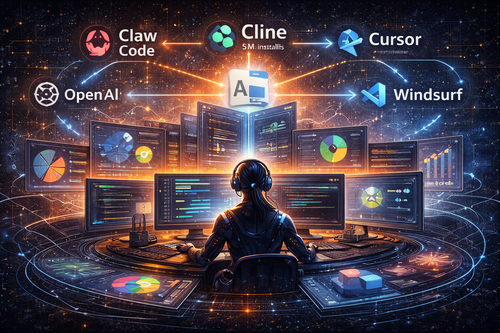
The community's response to the leak wasn't merely archival. Within hours, active projects emerged seeking to replicate, improve, or redesign the Claude Code orchestrator. The three most significant are Claw Code, Cline, and the projects derived from the original leaked code.
Claw Code represents the most ambitious approach. Created by developer @realsigridjin, this project doesn't just host the leaked code, but reimplements it from scratch using Rust for the runtime and Python for the metadata layer.
The legal strategy is interesting: by rewriting the code instead of copying it directly, the creators argue that it's a clean-room rebuild that avoids copyright issues. However, this legal theory has yet to be tested in court, and the question of whether an AI-assisted rebuild constitutes copyright infringement remains unanswered.
Claw Code has garnered over 75,000 stars and 75,000 forks in its original repository, and the project has been ported to Python by other developers, accumulating over 111,000 stars in total. The project includes three unique tools not even the official Claw Code has: push notifications to contact the user even when the terminal is closed, file delivery without prior request, and pull request subscriptions that allow the agent to react to code changes automatically.
Cline, on the other hand, existed before the leak, but has experienced a massive resurgence as a mature open-source alternative. With over 58,000 stars on GitHub and 5 million installations in VS Code, Cline offers agentic capabilities similar to Claude Code but directly within the Visual Studio Code editor. Its Plan and Act architecture separates information gathering from code changes, providing step-by-step approval that prevents surprise edits.
Unlike Claude Code, which only works with Anthropic models, Cline supports any LLM provider, including free local models.
A third approach involves projects that directly use the leaked code as the basis for new tools. These forks, while technically vulnerable to DMCA takedown requests, have proliferated on decentralized servers and alternative repositories. Some developers are porting the code to Python from TypeScript, while others are adapting it to run with local models, completely eliminating dependence on third-party APIs.
Is your company evaluating how to securely and strategically integrate coding tools with AI? At Presticorp, we analyze your current infrastructure, assess vendor dependency risks, and design hybrid architectures that maximize productivity without compromising technological sovereignty. Schedule an AI maturity audit with our specialists.
| Feature | Claw Code | Cline | Claude Code official | Cursor | Windsurf |
|---|---|---|---|---|---|
| Project type | Open source reimplementation | Extension vs open source code | Proprietary terminal | Proprietary ide (fork vs code) | Proprietary ide (fork vs code) |
| License | Open source (rust/python) | Open source (TypeScript) | Owner | Owner | Owner |
| Supported models | Anyone (flexible) | Any (75+ suppliers) | Only Claude (anthropic) | Multiple (claude, gpt, gemini) | Multiple (gpt, claude, gemini) |
| Price | Free (byo api key) | Free (byo api key) / $20 equipment | $20–200/month | $20–200/month | $15–60/month |
| Autocomplete | No (native terminal) | Yes (via vs code) | No | Yes (leader in quality) | Yes (super complete) |
| Self-employed agents | Yes (kairos included) | Yes (native sub-agents) | Yes (agent teams) | Yes (composer/cloud agents) | Yes (cascade) |
| Maximum context | 1m tokens | 1m tokens | 1m tokens | 256k–1m depending on the model | Variable |
| Facilities/stars | 111k+ stars | 5m+ facilities | Not available | 1m+ users, $2b+ arr | Acquired by cognition |
| MCP support | Yeah | Yeah | Yeah | Yeah | Yeah |
| Learning curve | Media (terminal) | Baja (family ID) | Media (terminal) | Baja (family ID) | Baja (family ID) |
This comparison reveals that emerging open-source projects not only replicate the functionalities of commercial tools, but in some cases surpass them in model flexibility and cost. The main disadvantage remains the lack of official support and the potential instability of rapidly developing projects.
-(1)-0402174916.png)
Timeline of the Claude Code orchestrator leak and the explosion of forks on GitHub, showing the growth of derivative open source projects in the first 48 hours. Source: Aggregated data from GitHub and reports from TechCrunch/Engineer's Codex, April 2026.
The central question facing Cursor, Windsurf, and other commercial IDEs is whether these forks represent substantial competition or simply a curiosity within the developer community. Indicators suggest the threat is real and growing.
First , the adoption of open-source tools in software development has powerful precedents. VS Code itself, the editor on which both Cursor and Windsurf are based, began as an open-source project and ended up dominating the market. Git, Linux, and Docker followed similar trajectories. Professional developers, particularly in startups and small businesses, show high sensitivity to price and the flexibility of business models.
Secondly , forks are innovating faster in some areas than commercial tools. Claw Code includes features like KAIROS that Anthropic hasn't officially released yet, and Cline offers per-task cost transparency that no commercial tool provides. This innovation advantage stemming from forced code exposure could persist if Anthropic maintains its closed-source approach.
Third, the business model of commercial IDEs is under pressure. Cursor has experienced growing complaints about its credit system, which can raise the monthly cost from $20 to $40-50 for heavy users. Windsurf, while cheaper at $15 per month, was acquired by Cognition AI in February 2026, creating uncertainty about its future roadmap.
Free forks, which only require payment for the use of model APIs, offer an attractive alternative for cost-conscious developers.
However, commercial tools retain significant advantages. Deep integration with enterprise ecosystems, official technical support, guaranteed stability, and a polished user experience are factors that open-source projects cannot yet match. Cursor, with over $2 billion in recurring annual revenue and a valuation of $9.9 billion, has the resources to innovate rapidly.
-(1)-0402175526.png)
Architectural comparison between the original Claude Code orchestrator and its open-source reimplementations, highlighting the separation between the model layer, agent orchestrator, and user interfaces. Source: Technical analysis of Claw Code and Cline project documentation, April 2026.
From Anthropic's perspective, the leak presents an ambiguous picture. On the one hand, the company has lost control over its most valuable intellectual property after the models themselves. The orchestrator represents years of refined software engineering, and its free availability to competitors erodes Claude Code's competitive advantage.
On the other hand, the proliferation of forks compatible with multiple models could indirectly expand the Anthropic ecosystem.
If Claw Code and similar projects allow users to experience agentic workflows similar to Claw Code but with free or cheaper models, some of those users might eventually migrate to the official version of Anthropic in search of greater reliability and performance. This "gateway" effect is common in open source software.
Furthermore, the leak has generated a massive amount of free publicity for Claude Code. The project was a topic of discussion in virtually every developer forum, tech newsletter, and social media platform during the first week of April 2026. This visibility, while negative in tone, keeps Anthropic at the center of the conversation surrounding AI-powered coding tools.
Anthropic's response strategy will be critical. So far, the company has opted for legal containment (DMCA requests) and public minimization (characterizing the incident as a packaging error). However, a more proactive strategy could involve the controlled release of parts of the orchestrator, similar to how Meta has handled models like Llama, or the creation of an official "community" version to compete directly with the forks.
-(1)-0402180228.png)
Competitive map of the AI-assisted coding tools market in 2026, showing the positioning of commercial IDEs versus new open-source competitors resulting from the Claude Code leak. Source: Market analysis based on adoption and funding data, April 2026.
| Scenery | Probability | Description | Impact on Anthropic | Impact on Cursor/Windsurf |
|---|---|---|---|---|
| Forks dominate free segment | 35% | Claw Code and Cline capture more than 40% of individual developers. | Loss of entry-level users, possible shift to a freemium model. | Price pressures and the need for premium differentiation. |
| Stabilization with niches | 45% | Forks hold between 15% and 20% of the hobbyist market, while commercial solutions dominate the enterprise segment. | Expanded ecosystem and organic conversion to payment models. | Limited competition, focus on enterprise functionalities. |
| Integration or absorption | 15% | Anthropic acquires or integrates open source projects. | Regaining control and consolidating community. | Minor disruption if Anthropic prioritizes differentiation. |
| Regulation or legal | 5% | Copyright disputes lead to the closure of relevant forks. | Intellectual property protection, but with possible reputational damage. | Indirect beneficiaries in the face of market uncertainty. |
These projections suggest that the most likely scenario is a coexistence where open-source forks serve individual developers and small teams, while commercial solutions maintain the enterprise segment. However, the dividing line between these segments is porous, and downward pressure on prices will be inevitable.
The rapid pace of change in the AI development ecosystem demands constant vigilance. If your organization relies on AI-assisted coding tools, it's time to assess your exposure to risks such as data breaches, price changes, and technological obsolescence. Contact Presticorp for a risk assessment of your current development stack and mitigation options.
As an analyst who has followed the evolution of AI development tools since their inception, I want to offer perspectives that transcend immediate market analysis.
First suggestion: the orchestrator's filtering is more significant than the filtering of a model would have been. Models are commodities, increasingly accessible and cheap. The effective orchestration of those models is where the differentiating value lies. Anthropic accidentally gave away its most sustainable advantage, not its most replicable asset.
Second suggestion: developers are voting with their forks. The speed of adoption of Claw Code and similar projects isn't just technical curiosity; it's an implicit rejection of commercial IDE pricing models. When 111,000 developers crash a project in 24 hours, they're sending a message about the perceived value of existing tools.
Third suggestion: Claw Code's "clean room" strategy is a fascinating legal experiment. If the courts determine that reimplementing AI-assisted code constitutes legitimate use, this would set a precedent that would dramatically accelerate the cloning of proprietary software. If the courts rule otherwise, the project would face massive shutdowns. The uncertainty itself is freezing investment in the space.
Fourth suggestion: Anthropic should consider Microsoft's "embrace and extend" strategy from the 1990s. Instead of fighting forks, it could adopt the most promising ones, provide them with official resources, and turn them into distribution channels. This would require a corporate humility rarely seen in high-value AI companies, but it would be strategically astute.
Fifth suggestion: For developers evaluating tools, the lesson is to diversify. There's no reason to commit exclusively to a single IDE or coding agent. Combining Cline for daily work in VS Code, Claude Code for complex refactoring tasks, and Claw Code for experimenting with local models offers comprehensive coverage for a fraction of the cost of a single proprietary solution.
The fragmentation of the AI-powered IDEs market creates opportunities but also decision complexity. Open source or proprietary? On-premises or cloud-based? Single model or multi-model? At Presticorp, we help engineering teams navigate these decisions with technical and financial evaluation frameworks. Book a consultation to define your 2026-2027 development tools strategy.
The leak of Claude Code's orchestrator represents a turning point in the democratization of AI development tools. For the first time, individual developers and small teams have access to the same orchestration architecture that powers tools valued at billions of dollars.
The forks that have emerged, particularly Claw Code and the resurgence of Cline, are not mere clones. They are evolutions that introduce their own innovations: flexible models, cost transparency, and experimental features that commercial companies are not yet willing to launch.
This is forcing Cursor, Windsurf, and eventually Anthropic itself to reassess their pricing and opening strategies.
For Anthropic, the challenge is to turn this crisis into an opportunity. The company can try to close the forks through legal action, a battle likely impossible to win completely, or it can embrace the expansion of its ecosystem and find ways to monetize the superiority of its models within a more open infrastructure.
For developers, the net result is positive. Increased competition will accelerate innovation, reduce prices, and increase transparency in a market that has thus far operated with proprietary black boxes. The March 31, 2026, leak, far from being simply a security error, can be remembered as the event that definitively opened agentic coding tools to the open-source world.
-
-
-
-
-
-
-
Engineer's Codex. Diving into Claude Code's Source Code Leak. April 1, 2026. Detailed technical analysis of the leak, KAIROS architecture, and derivative projects such as Claw Code.
Threads/@carnage4life. The Python fork of the leaked Claude Code source code. April 2, 2026. Reported 111,000 stars and 98,000 forks in 24 hours.
GitHub - ringmast4r/claw-cli-claude-code-source-code-v2.1.88. Claude Code (Leaked Source Archive). Archived repository of the leaked source code with documentation for rebuilding it in Rust.
Eigent AI. Claw Code vs Claude Code (2026): Open-Source GitHub Clone & Architecture. April 1, 2026. Technical comparison between Claw Code and the official Claude Code.
Taskade Blog. 15 Best Claude Code Alternatives: AI Coding Tools (2026). March 14, 2026. Comparative analysis of alternatives including Cline, Aider, and OpenCode.
Morph LLM. Claude Code Alternatives (2026): 11 Tested, 3 That Beat It for Under $20/mo. February 28, 2026. Evaluation of alternatives with performance and price metrics.
Birjob. The AI Coding Tool Wars: Cursor vs. Claude Code vs. GitHub Copilot vs. Windsurf. March 25, 2026. Market analysis with ARR and adoption data.
NXCode. Cursor vs Claude Code vs GitHub Copilot 2026 (Ultimate Comparison). April 1, 2026. Updated post-leak technical comparison.
DigitalOcean. 10 Claude Code Alternatives for AI-Powered Coding in 2026. February 11, 2026. Selection guide for different developer profiles.
Randal Olson. The Claude Code leak in four charts: half a million lines, three accidents, forty tools. April 2, 2026. Quantitative analysis of the leaked code.
Times of India. Anthropic's Boris Cherny, creator of $2.5 billion coding tool, makes a 'clarification' on Claude Code leak. April 2, 2026. Coverage of Anthropic's official response and context of the $2.5B ARR.
Straiker. Claude Code Source Leak: With Great Agency Comes Great Responsibility. April 1, 2026. Analysis of the security and governance implications of autonomous agents.

Si tu proyecto requiere una solución más enfocada, entra directo a la landing ideal para tu negocio y envíanos tu información en el formulario correspondiente.








0 Comentarios