








Norway halts AI glasses, ChatGPT launches visual ads, and Google freezes its bug hunt
Artificial intelligence kicked off the week with three fronts that touch on something very commonplace: what we wear, what we see on screen, and the security of the software we use without thinking. Norway wants to temporarily ban AI-powered glasses in parks, beaches, and gyms due to fears of unauthorized recordings. OpenAI confirmed that ChatGPT will display ads with images while you generate your own. And Google had to freeze its open-source bug bounty program because the avalanche of AI-generated reports, almost all of them invalid, overwhelmed its engineers.
Norway wants to ban AI-powered glasses in public spaces
The Norwegian government announced on Monday, October 5, 2026, that it will propose a temporary ban on the use of AI-powered glasses in selected locations. The reason, according to Reuters, is concern that people could be photographed, filmed, or audio-recorded without their knowledge.
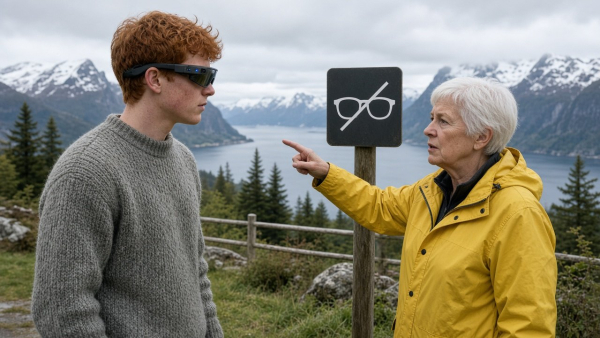
"I am concerned that a powerful new technology is being introduced that puts people at risk of being photographed, filmed, or recorded without their knowledge," said Torgeir Micaelsen, Minister of Digitalization and Public Governance.
Where would the veto apply?
The list is extensive: parks, beaches, museums, shopping centers, and public events. It could also extend to schools, daycare centers, playgrounds, and youth clubs, as well as particularly sensitive locations such as medical clinics, swimming pools, and gyms with changing rooms and showers. Authorities will consider including universities and other higher education institutions.
The government clarified that it is not seeking a total ban. Private use, and use in situations where no one is at risk of being recorded without consent, would remain permitted. It remains to be defined exactly which technology will be covered: whether only glasses with cameras and microphones, those that combine cameras and AI, or also other wearable devices with cameras, audio recording capabilities, or AI.
The minority government will introduce a bill "as soon as possible" and will create an expert group to advise on permanent national regulation of wearable technology. Meanwhile, Education Minister Kari Nessa Nordtun has asked municipalities to ban AI-enabled glasses in schools.
Why it matters outside of Norway
The proposal, Reuters notes, adds to a global backlash against smart glasses with cameras due to privacy concerns. The Norwegian approach, which limits use based on location rather than banning the device altogether, could serve as a model for other countries debating how to regulate wearable technology with cameras, microphones, and artificial intelligence.
Sources: Reuters via CNA , Anadolu Agency
ChatGPT debuts visual ads while you generate images
On Monday, OpenAI unveiled a new visual ad format for ChatGPT. According to the company, the service reaches 1.2 billion people each week, making it "the world's largest AI-native consumer platform." Advertising, OpenAI argues, allows it to serve a much larger market than subscriptions alone.

The new ads will use product inspiration images, showcasing the product in use or the experiences it enables. Initially, they will appear during image generation in ChatGPT, be clearly labeled, and remain separate from the user-generated image. Testing will begin later in October in the United States with an initial group of advertisers.
What changes for users and brands
As The Verge notes, OpenAI first introduced ads to ChatGPT in February, but until now they only displayed the company's name, logo, and a link in a "sponsored" section below the conversation. The ads will not appear for subscribers to the Plus, Pro, or Enterprise plans, and the company insists that advertising does not influence ChatGPT responses.
OpenAI also expanded its measurement tools: integrations with Hightouch, Tealium, and LiveRamp to send conversion data, and attribution partners such as AppsFlyer, Adjust, Branch, and DV Rockerbox. Among the first results it cites, according to DV Rockerbox, WeightWatchers' attributed cost per acquisition in ChatGPT Ads was 15.3% lower than its paid search benchmark.
Brand safety without reading conversations
To build trust with advertisers, OpenAI is preparing pilot evaluations with DoubleVerify and Integral Ad Science. These pilots will review how OpenAI applies its brand safety standards in a controlled testing environment, without access to private conversations. Its placement filters aim to keep advertising out of emotionally vulnerable, sensitive, or inappropriate contexts. This move confirms that the advertising business is already a core component of OpenAI's model.
Google freezes its open-source bug bounty program over AI junk
The third piece of news reveals the less glamorous side of AI. Google has suspended new applications to its Open Source Software Vulnerability Rewards Program (OSS VRP), the program that pays researchers for finding security flaws in its open-source software. "This pause is due to a significant increase in automated submissions, the vast majority of which are invalid," the company explained.

The pause is in effect from October 1, 2026, and Google promises an update in the first quarter of 2027. According to Tom's Hardware, cited by TechCrunch, Google engineers and project maintainers were overwhelmed with invalid or hallucinatory reports.
What is excluded from the freeze
The OSS VRP was launched in August 2022, with rewards ranging from $100 to $31,337, and covers projects such as Golang, Angular, Bazel, Protocol Buffers, and Fuchsia, among others. The pause does not affect supply chain reports, pending cases, or vulnerabilities submitted before October 1. Researchers can continue using the Patch Rewards Program, with prizes up to $15,000, or the Cloud VRP for vulnerabilities in Google Cloud repositories.
A problem that is spreading
Google isn't the first. According to BleepingComputer, in January the maintainer of curl shut down its program on HackerOne due to a flood of AI-generated junk reports, and in mid-September Intel withdrew the financial rewards from its program on Intigriti. It's an uncomfortable irony: the very AI that promises to find vulnerabilities faster is overwhelming those who are supposed to verify them. Since 2010, Google has paid more than $81.6 million to researchers, with a record $17.1 million in 2025.
Sources: TechCrunch , BleepingComputer
What connects these three fronts?
Glasses that record without warning, ads that intrude on your images, and fake reports that overwhelm security experts all have something in common: AI is no longer a laboratory experiment, but something that lives alongside us on the street, on screen, and in code. And every time it gains ground, someone—a government, an advertiser, or a security team—has to establish new rules for coexistence.
Deja un comentario
Enviando comentario…
Herramientas
 EmiteDocs
Diplomas en lote: 3/semana gratis, hasta 1000 por $500. Contratos: desde $199, hasta 100.
EmiteDocs
Diplomas en lote: 3/semana gratis, hasta 1000 por $500. Contratos: desde $199, hasta 100.
 CrearPlantillas
Editor visual. 2 gratis/mes, 5/semana con cuenta, o 20 descargas por $69 MXN.
CrearPlantillas
Editor visual. 2 gratis/mes, 5/semana con cuenta, o 20 descargas por $69 MXN.
 TuRSVP
Invitaciones con RSVP. Desde $299 MXN, pago único.
TuRSVP
Invitaciones con RSVP. Desde $299 MXN, pago único.
 Minitareas
Tableros con Google. Libre: 1 tablero. Pro: $249 MXN al mes.
Minitareas
Tableros con Google. Libre: 1 tablero. Pro: $249 MXN al mes.
 Cotización de páginas web
Arma tu sitio por módulos y cotiza en MXN. Usarlo no tiene costo.
Cotización de páginas web
Arma tu sitio por módulos y cotiza en MXN. Usarlo no tiene costo.
 Convertidor de formatos
Convierte Excel, Word, PDF e imágenes. $150 MXN al mes, hasta 200.
Convertidor de formatos
Convierte Excel, Word, PDF e imágenes. $150 MXN al mes, hasta 200.
 Monitor Global
Clima, sismos, huracanes y tsunamis. Consulta gratis.
Monitor Global
Clima, sismos, huracanes y tsunamis. Consulta gratis.
 Promo a la vista
Catálogo gratis. Resumen gratis o desde $200/mes. Comida destacada: $500/mes.
Promo a la vista
Catálogo gratis. Resumen gratis o desde $200/mes. Comida destacada: $500/mes.
 Ravicom
Restaurantes y platillos. Buscar y registrar es gratis.
Ravicom
Restaurantes y platillos. Buscar y registrar es gratis.
Articulos recomendados


Presticorp
Landing pages especializadas
¿Proyecto totalmente personalizado? Contáctanos.
Si tu proyecto requiere una solución más enfocada, entra directo a la landing ideal para tu negocio y envíanos tu información en el formulario correspondiente.
Startups
MVP, validación de idea, producto digital y escalabilidad.
Pymes
Marketing digital, captación de clientes y crecimiento comercial.
E-commerce
Tiendas en línea, catálogo, checkout y ventas automatizadas.
Soluciones empresariales
Sitios corporativos, automatización y soluciones digitales a medida.
Promo a la vista
Promociones más recientes
Ofertas vigentes del catálogo, de la más nueva a la más antigua.
Ver promociones Tenis adidas Campus 00s para mujer (−50%)
Tenis adidas Campus 00s W de gamuza para mujer, modelo JQ8333
Tenis adidas Campus 00s para mujer (−50%)
Tenis adidas Campus 00s W de gamuza para mujer, modelo JQ8333
 Camiseta gym manga larga hombre CRZ YOGA Brushed Slim-Fit (−50%)
Camiseta deportiva de manga larga para hombre CRZ YOGA Brushed Slim-Fit, ideal para gym y correr
Camiseta gym manga larga hombre CRZ YOGA Brushed Slim-Fit (−50%)
Camiseta deportiva de manga larga para hombre CRZ YOGA Brushed Slim-Fit, ideal para gym y correr
 Combo Sony: tocadiscos PS-LX3BT + audífonos WH-1000XM4C noise cancelling
Combo Sony: tocadiscos Bluetooth PS-LX3BT + audífonos inalámbricos con noise cancelling WH-1000XM4C
Combo Sony: tocadiscos PS-LX3BT + audífonos WH-1000XM4C noise cancelling
Combo Sony: tocadiscos Bluetooth PS-LX3BT + audífonos inalámbricos con noise cancelling WH-1000XM4C
 Tenis PANAM Flip Panteón Rococó unisex (−48%)
Tenis choclo PANAM Flip edición Panteón Rococó 30 años, unisex, hecho en México
Tenis PANAM Flip Panteón Rococó unisex (−48%)
Tenis choclo PANAM Flip edición Panteón Rococó 30 años, unisex, hecho en México









0 Comentarios