










On August 12, 2026, SpaceXAI—the company that publishes Grok on x.ai and whose documentation still refers to it as xAI—unveiled Grok 4.6. It's not a gadget or a hardware "book": it's the company's front-end model, designed for agents who spend many steps on a single task, for working with a repository, and for transforming an idea into a usable artifact. Two weeks later, on August 28, the announcement was no longer just lab news. The model was available in Cursor, Grok Build, the API, gateways like OpenRouter, Vercel, and Cloudflare, and had begun appearing in enterprise clouds. This is important because it brings Grok to teams that already have a publisher or a cloud account, not just to those who visit grok.com.
The main news isn't that Grok "responds better." It's that the manufacturer positions it to handle long-term work: researching, analyzing, traversing code, or iterating on an application. This analysis separates what SpaceXAI claims from what a company can responsibly conclude. We reviewed availability, pricing, limitations, and a thirty-day adoption plan. The goal isn't to declare a winner over Claude or OpenAI, but to determine where a Grok agent adds value and how to prevent a cheap trial from turning into a costly bill or risk.
SpaceXAI describes Grok 4.6 as an evolution of Grok 4.5, with an emphasis on long-lived agents and more ambitious interactive and visual work. In the official documentation, it is the frontier model for code, agentic tasks, and knowledge work. The API identifier is grok-4.6. The context window is 500,000 tokens; it supports text and image input and outputs text; it does not publish an output cap. Reasoning is controlled with low, medium, high (default), or xhigh, and cannot be disabled. It offers function calling, structured output, web search, X search, and code execution.
There's a documentary nuance that shouldn't be overlooked. The Grok 4.6 data sheet indicates a knowledge cutoff date of January 2026; the model catalog specifies February 1, 2026. In both cases, the model doesn't "know" what happened afterward, unless search tools are activated. Don't treat it as a living archive of your industry.
The announcement includes a table of its own evaluations. SpaceXAI claims, for example, a score of 61 on the Artificial Analysis Intelligence Index (the same as GPT-5.6 Sol Max in that table), 69.9% on CursorBench v3.2, 65.9% on DeepSWE v1.1, and 26% on Terminal-Bench v3.0. These figures come from the manufacturer. They are not an independent audit, nor do they predict the results in their repository. The product change, however, is concrete: the model is already being invoked, already being billed, and already being used in everyday tools.
A useful agent does not eliminate human judgment: it sustains a long task, uses tools, and presents a result for a person to authorize the sensible.
The business value emerges in the follow-through. Many models draft an email or a patch; fewer systems maintain the objective when the job requires opening documentation, comparing files, fixing an exception, and retesting. SpaceXAI says it saw more self-testing on long trajectories and more robust first passes in visual projects with Grok 4.6 than with Grok 4.5. That's a lab claim. What a company can use immediately is the product surface:
It's best not to mix products. Grok at grok.com is the chat, file, voice, and Imagine assistant. Grok Build is the development agent. Grok Bot is something else entirely: coworkers on a cloud-based computer, currently in beta. There isn't, as of now, an official product called "Grok Book." If someone searches for that name, what exists is this model and these interfaces: the "open book" of Grok is, in practice, the documentation, the API, and the agent that works with code or a set of files.
There is no unlimited autonomy either. Distinguish three layers: thinking (summarizing, proposing), preparing (generating a change not yet implemented), and acting (modifying data, sending, deploying, or deleting). Grok 4.6 can participate in all three if given the tools, but the permissions should not be the same for each layer. The leap from preparing to acting requires identity, boundaries, records, and approval.
The useful difference is not "a smarter chatbot", but a system that preserves the objective and leaves a revisable artifact.
In the API, the official Grok 4.6 list (per million tokens, in dollars) is:
The advertisement summarizes the price as “from $2 to $6” and mentions a fast variant at double the price. The catalog consulted on August 28th does not list a separate identifier like grok-4.6-fast. Priority Processing is documented: it doubles the rates when the response confirms service_tier: "priority". Grok 4.6 does not support Batch API. Server tools are charged separately: $5 per 1,000 web search, X search, or code execution calls.
A monthly flow of one million incoming tokens and two hundred thousand outgoing tokens would cost about $3.20 in the short term, before additional reasoning, caching, and tools. If the prompt reaches 200,000 tokens, that same mix is billed at $4 and $12, respectively: about $6.40. This is an estimate, not a quote. An agent rereads context and can repeat steps; the cost depends more on the number of cycles and the level of reasoning than on the isolated price of a call. The documentation emphasizes setting a prompt_cache_key (or the x-grok-conv-id header) to avoid paying for full input on a "cold" server.
For the consumer product, grok.com starts free. SuperGrok costs $30 per month and includes Grok 4.6, Grok Bot, connectors, and Imagine. SuperGrok Plus costs $100 per month and adds more usage, 1080p video, and priority access during peak hours. There are also SuperGrok Lite, SuperGrok Heavy, Business, and Enterprise plans; the prices for Lite and Heavy weren't displayed in static text on the plans page, so we didn't make them up. The paid plans share a weekly data allowance; once it's depleted, you can buy extra credit (starting at $5 on the website). During the first week after launch, SpaceX AI offered double the included usage for Grok Build and Cursor; that incentive has since expired.
The correct metric is not the price per million tokens, but the cost of completing a task with the required quality and control.
The token handles 150 requests per second and issues 50 million tokens per minute, in US East 1 and US West 2. Input images accept JPEG and PNG, up to 20 MiB. Reasoning is billed as tokens. SpaceXAI claims it calibrated safeguards "in line with the capabilities" of the model. The announcement does not include a system card as detailed as those typically accompanying an Anthropic Sonnet. The responsible conclusion is narrow: there is a discourse on security, but that does not replace external controls. An agent navigating or executing code can still encounter instruction injection. Permissions must reside outside the model: separate credentials, minimal-scope tools, and human confirmation before irreversible actions.
Security must live in the architecture: the model interprets instructions; credentials and approvals determine how far it can act.
Software development. This is the model SpaceXAI recommends for code. In Grok Build or Cursor, you can explore a repository and propose a patch. The best use is not to blindly accept code, but to accelerate the diagnostic-test-review cycle.
Knowledge work and prototypes. Fits with dossiers, comparisons, and first drafts. A generated quote doesn't become true just because it's formatted as a footnote. The manufacturer claims stronger first passes than Grok 4.5 when moving from an idea to a visual structure; treat it as an accelerator, not a closed design team. Function calling allows for read and change preparation workflows: first read, then reverse actions, and finally impact operations with double approval.
If the team is already living on AWS, Bedrock is offering the model at $2/$0.50/$6 per million in the tier published on August 19. It's been in public preview on Microsoft Foundry since August 26, with the same list price for the Global Standard SKU. "It's on my cloud" doesn't mean "it's already governed": you need to check residency, threads, and whether the contract supports this provider.
Week 1: Build the test. Choose a frequent, measurable, and reversible process. Gather 20 to 30 real-world cases, including errors. Define the correct answer, the current human time, and unacceptable failures. Run Grok 4.6 and your current model under the same conditions. In the API, start with `reasoning_effort` set to `high` and reserve `xhigh` for a difficult subset.
Week 2: Connect in read mode. Integrate repository or documents with write-free credentials. Activate prompt_cache_key. Record tokens, tools, and whether the request exceeded 200,000 tokens.
Week 3: Enable bounded actions. Allow the agent to prepare a patch or update, and have a person approve it. If no one knows how to undo an action, the agent should not execute it yet.
Week 4: Measure and decide. Compare successful completion rate, time, cost per outcome, human intervention, and rework. If the cost spikes, look first at loops, reasoning level, the 200,000 token threshold, and cold caching, not the $2 line item.
Responsible adoption progresses from a siloed environment to production through evidence, progressive permissions, and human oversight.
Use traditional automation when rules are stable. Consider Grok 4.6 for code, research with tools, and multi-step agents, especially if the team is already on Cursor, Grok Build, or a cloud service that offers it. Reserve a less expensive model—in the catalog, Grok 4.3 costs $1.25–$2.50 per million for the short term—when latency or price dictates it. Retain human intervention when errors affect rights, money, health, or reputation. Routing is advisable: rules for deterministic processes, Grok 4.6 for code or research, and a second vendor to avoid dependency on a single lab.
Grok 4.6 seems important because SpaceXAI is selling a model for completing tasks: in the editor, in the terminal, in the API, and increasingly, in the client's cloud. The list price of $2 and $6 makes testing affordable. However, the 200,000 token threshold, the fact that it cannot be turned off, and the payment methods mean that affordability is not automatic.
My recommendation is straightforward. Don't look for a product called "Grok Book"—it's not in the catalog. Choose a process that currently consumes at least five hours per week, create a test suite with real-world scenarios, and run a seven-day pilot reading test with grok-4.6. If the agent can't explain what they did, cite what they used, and stop before a critical action, they're not ready. If they can, enable a single reversible action and measure again. Don't adopt a model based on a 61 on a composite index. Adopt it based on its performance in your work, with your data, and your definition of success.
SpaceXAI. “Introducing Grok 4.6”. August 12, 2026. https://x.ai/news/grok-4-6
SpaceXAI. “Grok 4.6” (Developer Documentation). Retrieved August 28, 2026. https://docs.x.ai/developers/grok-4-6
SpaceXAI. “Grok 4.6” (model sheet: segment pricing, limits, and regions). Retrieved August 28, 2026. https://docs.x.ai/developers/models/grok-4.6
SpaceXAI. “Models” (catalog and knowledge cutoff as of February 1, 2026). Retrieved August 28, 2026. https://docs.x.ai/developers/models
SpaceXAI. “Pricing” (API: Tiers, Tools, Batch and Priority Processing). Retrieved August 28, 2026. https://docs.x.ai/developers/pricing
SpaceXAI. “Reasoning” (low / medium / high / xhigh levels). Retrieved August 28, 2026. https://docs.x.ai/developers/model-capabilities/text/reasoning
SpaceXAI. “Grok Build”. Retrieved August 28, 2026. https://docs.x.ai/build/overview
SpaceXAI. “Welcome to Grok” (grok.com, iOS, Android, and weekly stock market). Retrieved August 28, 2026. https://docs.x.ai/grok/overview
SpaceXAI. “FAQ - Grok Website / Apps”. Retrieved August 28, 2026. https://docs.x.ai/grok/faq
SpaceXAI. “Pricing: Compare Grok Plans” (Free, SuperGrok $30, SuperGrok Plus $100). Accessed August 28, 2026. https://x.ai/pricing
SpaceXAI. “Grok 4.6 on Amazon Bedrock”. August 19, 2026. https://x.ai/news/grok-4-6-amazon-bedrock
Microsoft. “Grok 4.6 comes to Microsoft Foundry Models”. August 26, 2026. https://techcommunity.microsoft.com/blog/azure-ai-foundry-blog/grok-4-6-comes-to-microsoft-foundry-models-built-for-long-horizon-reasoning-and-/4547578
Editorial note: The performance figures cited are from evaluations published by SpaceXAI. They should be validated with your own testing before deciding on a purchase or automation. The public trade name on x.ai is SpaceXAI; the API and several documents still use xAI.
If this article on "Grok 4.6: SpaceXAI's AI for code agents and knowledge work" leaves you wanting more, the next natural step is "
" and " "Enviando comentario…
 EmiteDocs
Diplomas en lote: 3/semana gratis, hasta 1000 por $500. Contratos: desde $199, hasta 100.
EmiteDocs
Diplomas en lote: 3/semana gratis, hasta 1000 por $500. Contratos: desde $199, hasta 100.
 CrearPlantillas
Editor visual. 2 gratis/mes, 5/semana con cuenta, o 20 descargas por $69 MXN.
CrearPlantillas
Editor visual. 2 gratis/mes, 5/semana con cuenta, o 20 descargas por $69 MXN.
 TuRSVP
Invitaciones con RSVP. Desde $299 MXN, pago único.
TuRSVP
Invitaciones con RSVP. Desde $299 MXN, pago único.
 Minitareas
Tableros con Google. Libre: 1 tablero. Pro: $249 MXN al mes.
Minitareas
Tableros con Google. Libre: 1 tablero. Pro: $249 MXN al mes.
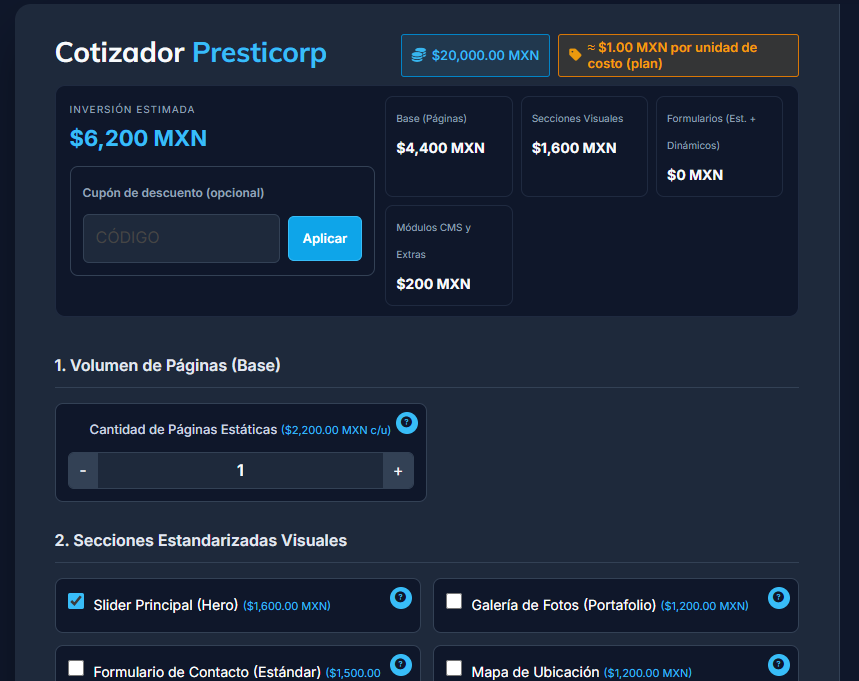
 Cotización de páginas web
Arma tu sitio por módulos y cotiza en MXN. Usarlo no tiene costo.
Cotización de páginas web
Arma tu sitio por módulos y cotiza en MXN. Usarlo no tiene costo.
 Convertidor de formatos
Convierte Excel, Word, PDF e imágenes. $150 MXN al mes, hasta 200.
Convertidor de formatos
Convierte Excel, Word, PDF e imágenes. $150 MXN al mes, hasta 200.
 Monitor Global
Clima, sismos, huracanes y tsunamis. Consulta gratis.
Monitor Global
Clima, sismos, huracanes y tsunamis. Consulta gratis.
 Promo a la vista
Catálogo gratis. Resumen gratis o desde $200/mes. Comida destacada: $500/mes.
Promo a la vista
Catálogo gratis. Resumen gratis o desde $200/mes. Comida destacada: $500/mes.
 Ravicom
Restaurantes y platillos. Buscar y registrar es gratis.
Ravicom
Restaurantes y platillos. Buscar y registrar es gratis.


Si tu proyecto requiere una solución más enfocada, entra directo a la landing ideal para tu negocio y envíanos tu información en el formulario correspondiente.
Ofertas vigentes del catálogo, de la más nueva a la más antigua.
Ver promociones Cupón Steam: Warhammer 40,000: Space Marine 2 a $199.99 (−75%, antes $799.99, vence 24 oct 2026)
Juego para PC Warhammer 40,000: Space Marine 2 (Steam, versión estándar) con 75% de descuento
Cupón Steam: Warhammer 40,000: Space Marine 2 a $199.99 (−75%, antes $799.99, vence 24 oct 2026)
Juego para PC Warhammer 40,000: Space Marine 2 (Steam, versión estándar) con 75% de descuento
 Guantes de Cardio Elite 2 Everlast a $399 en Everlast México (antes $849, −53%)
Guantes de Cardio Elite 2 Everlast
Guantes de Cardio Elite 2 Everlast a $399 en Everlast México (antes $849, −53%)
Guantes de Cardio Elite 2 Everlast
 Cargador UGREEN Nexode 65W Tipo C Carga Rápida GaNRobot color negro a $653.64 en UGREEN México (antes $1,257, −48%)
Cargador UGREEN Nexode 65W Tipo C Carga Rápida GaNRobot color negro
Cargador UGREEN Nexode 65W Tipo C Carga Rápida GaNRobot color negro a $653.64 en UGREEN México (antes $1,257, −48%)
Cargador UGREEN Nexode 65W Tipo C Carga Rápida GaNRobot color negro
 Robot aspiradora Roborock Q7 L5+ con estación de autovaciado a $6,799 en Roborock México (antes $15,999, −58%)
Robot aspiradora Roborock Q7 L5+ con estación de autovaciado
Robot aspiradora Roborock Q7 L5+ con estación de autovaciado a $6,799 en Roborock México (antes $15,999, −58%)
Robot aspiradora Roborock Q7 L5+ con estación de autovaciado





0 Comentarios