






The platform that promised to free work teams from the burden of operating costs has ended up being a case study in how not to manage the relationship with those who adopt your technology.
This article is not intended to demonize Google, nor is it meant to defend its competitors. It is a critical reflection on a pattern we are seeing repeated in the artificial intelligence industry: the tension between aggressive growth, hasty monetization, and the trust that companies place in their technology providers. Because at the end of the day, when a company decides to integrate an AI tool into its workflow, it is not just buying processing tokens. It is buying predictability.
When Antigravity first launched, it did so with seemingly sustainable pricing. The free tier offered 250 daily requests, a reasonable number for testing and prototyping. Paid users, for $20 a month, had access to limits that refreshed every five hours. The promise was clear: pay a modest fee and work without interruption. But in December 2025, without warning, Google reduced the daily requests for the free tier from 250 to 20. That's not an adjustment; it's a 92 percent amputation of the promised capacity.
The problem wasn't just the size of the cut. It was how it was implemented. No prior communication, no transition period, no guided migration. Applications that relied on the free API crashed overnight. Home Assistant integrations stopped working. Student projects ground to a halt. And the message the community received was devastating: what Google gives you today, it can take away tomorrow without asking.
The irony of a product called Antigravity, which promised to free developers from traditional limitations, only to end up imposing unexpected gravity in the form of opaque fees and arbitrary blocks, did not go unnoticed in developer forums.
In March 2026, Google introduced the AI credit system. At first glance, it seemed like an elegant solution: instead of rigid limits, users would buy flexible credits. Twenty-five dollars for 2,500 credits. The problem is that no one knows exactly what they're buying with a credit. Google's documentation doesn't specify the conversion rate between credits and tokens. It's unclear whether a request to Claude Opus 4.6 consumes the same number of credits as one to Gemini Flash. There are no cost tables per model. There are no usage calculators.
This isn't transparency; it's opacity disguised as something else. When a company contracts a cloud service, it expects to know the cost of each computing instance, each gigabyte of transfer, and each hour of storage. Artificial intelligence shouldn't be any different. However, Google opted for a model where the user pays without knowing what they're buying, like purchasing fuel for a car with no fuel gauge or price per liter.
AI Pro subscribers, who paid $20 a month with the promise of limits that would refresh every five hours, found that in practice the wait was five to seven days. One developer documented that before January they could process 300 million entry tokens per week; after the changes, they reached the limit with fewer than 9 million. That's a 97 percent reduction in effective capacity, while maintaining the same price.
Perhaps the most criticized element of Antigravity's pricing structure is the jump between AI Pro and AI Ultra. Twenty dollars a month versus 249.99 dollars. That's a difference of more than 12 times, with no intermediate options. There's no plan for small teams that need more than the basic tier but less than the absolute premium. There's no ladder, just a chasm.
To put it in perspective, with $250 a month a company could subscribe to Claude Pro, Cursor Pro, and GitHub Copilot, and still have $200 left over for additional API credits. Or they could hire a freelance developer on an hourly basis. The question every CTO should be asking is: Does the added value of Antigravity justify that cost, especially when even Ultra users haven't been spared unexpected caps since March 2026?
Google positions AI Ultra as the option for consistent, high-volume access to the most complex models. But when users of the most expensive tier report unannounced quota restrictions, the marketing message clashes head-on with the real-world experience.
| Date of change | Affected Tier | Change made | Impact on the user |
|---|---|---|---|
| December 2025 | Gratuitous | Reduction from 250 to 20 daily requests | Application crash in production |
| December 2025 | Gratuitous | Drop from 10 to 5 requests per minute | Constant 429 (Too Many Requests) errors |
| February 2026 | Gratuitous | Image generation quota adjustment | Interrupted multimodal workflows |
| March 2026 | All | Introduction to the AI credit system | Lack of transparency in cost and consumption management |
| March 2026 | Pro | Promise of renewal every 5 hours vs. reality of 5 to 7 days | Total project shutdown for days |
| March 2026 | Ultra | Dramatic reduction of fees without prior notice | Critical frustration at the highest pay level |
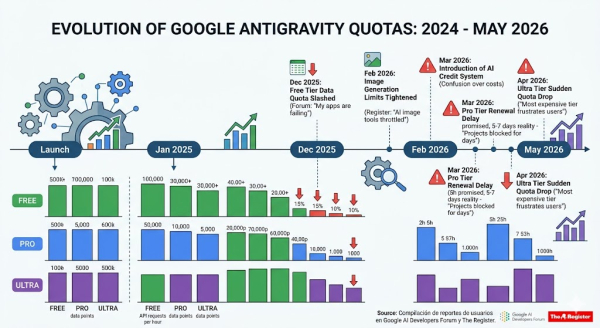
Evolution of Google Antigravity's market share from its launch until May 2026. Source: compilation of user reports from the Google AI Developers Forum and The Register.
Does your company rely on AI tools that can become unstable overnight? The technology decisions you make today will define your operational capacity tomorrow. Don't wait for an account suspension or a unilateral policy change to disrupt your critical workflow. Schedule a free technology audit with Presticorp and discover:
- Which AI tools in your current stack present critical dependency risks?
- How to diversify your AI providers without losing productivity.
- A low-risk migration roadmap towards more stable alternatives.
[Book your audit appointment now →]
The true cost of this strategy isn't measured in dollars, it's measured in trust. When a company decides to adopt an artificial intelligence platform, it's making a strategic decision that impacts its development pipeline, its team structure, and its technology architecture. It's not a decision that can be reversed overnight without cost.
Google has made the mistake of treating developers like consumers of an entertainment app, where switching platforms is as easy as downloading another app. But migrating an agent-based development workflow, with custom agents, browser integrations, and skill configurations, is not trivial. It requires an investment of time, training, and process adaptation.
Google's official documentation includes a clause that should alarm any executive: the specified speed limits are not guaranteed. Read that again. The company that charges you $250 a month for priority access doesn't guarantee that you'll actually get priority access. It's like paying for life insurance that says in the fine print that coverage isn't guaranteed.
In the same week in March 2026 that Google was quietly implementing cutbacks, Anthropic launched Claude Opus 4.6 with a context window of one million tokens, five times more capacity at the same price. The difference in philosophy is staggering. While Google was reducing its promises and demanding 12.5 times more payment to recover the lost value, Anthropic was delivering more value without increasing costs.
This isn't a product comparison; it's a comparison of organizational cultures. One company sees its users as partners to be retained with tangible value. The other seems to see them as a resource to be optimized down to the last penny of margin.
Cursor Pro, at $20 per month, offers clear boundaries, SOC 2 certification, and a mature development environment. GitHub Copilot, at $10, provides unlimited access to coding models. Windsurf Pro, at $15, uses a credit system but at least is transparent about how it works. Antigravity, on the other hand, offers multi-model and multi-agent support, yes, but at the cost of uncertainty that paralyzes planning.
-(1)-0511194118.jpeg)
Comparison of AI development tools in May 2026, highlighting the transparency gap between Google Antigravity and its direct competitors.
If there's one lesson companies should learn from the Antigravity crisis, it's that relying on a single vendor, especially when the rules of the game can change without warning, poses a significant operational risk. This isn't about technological paranoia; it's about cloud governance.
Organizations building their digital transformation on AI APIs should ask themselves: What if our provider reduces our capacity by 92 percent tomorrow? What if our operating costs increase twelvefold overnight? Do we have a plan B? Have we diversified our models and providers?
The answer is not to abandon artificial intelligence, but to adopt it strategically. This involves using architectures that allow for the exchange of models without rewriting all the code, and maintaining relationships with multiple vendors.
Negotiate service level agreements that include compensation for non-compliance. And, above all, don't confuse a free demo with a long-term strategy.
In the business world, cost opacity is a more powerful deterrent than price itself. An executive can justify a $250 monthly investment if they know exactly what return they'll get. But they can't justify a variable, unpredictable, and potentially unlimited expense. That makes Antigravity, from a business planning perspective, a liability rather than an asset.
My recommendation for companies evaluating AI tools right now is simple: demand transparency before handing over data, processes, and teams to any platform. If a vendor can't tell you how much a request to their most advanced model will cost, if they can't guarantee a minimum level of availability, if they reserve the right to change the rules without notice, then they're not a technology partner. They're a risk.
Artificial intelligence is undoubtedly the most disruptive technology of our time. But its sustainable adoption depends on providers understanding something fundamental: companies don't buy language models, they buy trust. And trust, once lost, cannot be recovered with AI credits.
If your company is navigating the complexities of integrating artificial intelligence into its operations, don't do it blindly. Schedule a digital transformation audit with Presticorp and discover how to evaluate vendors, diversify risks, and build an AI architecture that isn't dependent on the whims of a single platform.
Our specialists will analyze your current infrastructure, identify weaknesses, and design a technology roadmap that puts innovation at the service of your business, not the other way around.
-
-
-
-
-
-
-
-
-
-
-
1. The Register: Users protest as Google Antigravity price floats upward. March 2026. theregister.com/2026/03/12/users_protest_as_google_antigravity/
2. DevClass: Users protest as Google Antigravity price floats upward. March 2026. devclass.com/ai-ml/2026/03/13/users-protest-as-google-antigravity-price-floats-upward/5209219
3. Vibe Coding: Google AntiGravity Pricing 2026. April 2026. vibecoding.app/blog/google-antigravity-pricing-2026
4. AI Tool Analysis: Google Antigravity Review 2026. January 2026. aitoolanalysis.com/google-antigravity-review/
5. Claude World: Google Antigravity Cuts Quotas 92%. March 2026. claude-world.com/articles/google-antigravity-quota-cuts-vs-claude-code-opus-1m/
6. APIYI: Full analysis of the Google Antigravity quota cut incident. March 2026. help.apiyi.com/en/google-antigravity-quota-cut-policy-changes-developer-impact-guide-en.html
7. Techzine: Developers complain about Google Antigravity pricing structure. March 2026. techzine.eu/news/devops/139547/developers-complain-about-google-antigravity-pricing-structure/
If «Google Antigravity and the Hidden Cost of Artificial Intelligence: Why the Price of Innovation Shouldn't Be Trust» leaves the thread open, the natural next reads are «NULL» and «Google Antigravity and the crisis of confidence that Google doesn't want you to see: between price and fee...». pide precios de invitaciones/RSVP por escrito, como pedir tokens por escrito. On TuRSVP that lands in «NULL».
Enviando comentario…
 EmiteDocs
Constancias, diplomas, oficios y contratos en lote.
EmiteDocs
Constancias, diplomas, oficios y contratos en lote.
 CrearPlantillas
Editor visual de anuncios, plantillas y collage.
CrearPlantillas
Editor visual de anuncios, plantillas y collage.
 TuRSVP
Invitaciones digitales con RSVP para eventos.
TuRSVP
Invitaciones digitales con RSVP para eventos.
 Minitareas
Tableros personales para organizar el trabajo.
Minitareas
Tableros personales para organizar el trabajo.
 Cotización de páginas web
Arma tu sitio por módulos y cotiza en MXN.
Cotización de páginas web
Arma tu sitio por módulos y cotiza en MXN.
 Convertidor de formatos
Convierte Excel, Word, PDF, imágenes y más, gratis y sin registro.
Convertidor de formatos
Convierte Excel, Word, PDF, imágenes y más, gratis y sin registro.
 Monitor Global
Clima, sismos, huracanes y alertas en un mapa en vivo.
Monitor Global
Clima, sismos, huracanes y alertas en un mapa en vivo.
 Promo a la vista
Catálogo de ofertas del día y resumen por correo.
Promo a la vista
Catálogo de ofertas del día y resumen por correo.
 Ravicom
Restaurantes y platillos en tu ciudad, con ficha y mapa.
Ravicom
Restaurantes y platillos en tu ciudad, con ficha y mapa.


Si tu proyecto requiere una solución más enfocada, entra directo a la landing ideal para tu negocio y envíanos tu información en el formulario correspondiente.











0 Comentarios