








By the end of August 2026, choosing an AI-powered development environment is no longer about deciding "which autocomplete feels smartest." It's about deciding where the agent lives, which models it can use, who approves changes, and how payment is handled when the session lasts not three minutes, but an entire afternoon. Cursor is positioning itself as a code agent for ambitious software. Anthropic is selling Claude Code for the terminal, IDE, desktop, and web. OpenAI is offering Codex in ChatGPT, the editor, and the CLI. Cognition has rebranded Windsurf as Devin Desktop and is positioning it as a command center for fleets of agents.
This article doesn't declare a winner. It separates what each manufacturer claims on their official websites from what a team can conclude through its own testing. If your fundamental question is which model to use behind the editor, we've already published an analysis of the
—price, security, and a thirty-day plan. Here, the focus is different: the work surface. The model matters. The harness—where it operates, with what permissions, and with what human restraint—determines whether that intelligence reaches production or remains an expensive demo.
Cursor's documentation defines it as "a code agent for building ambitious software": understanding a repository, planning and building features, fixing bugs, reviewing changes, and connecting to the tools the team already uses. The Agent combines instructions, tools, and a model: it searches code and the web, edits files, executes commands, controls a browser, and can generate images. According to the documentation, there is no limit to the number of tool calls per task. Checkpoints save local snapshots—distinct from Git—to revert an agent deviation.
On the homepage, Cursor talks about cloud-based agents that build, test, and demonstrate features, and about "always-on" agents that are activated by schedule or trigger. The model selector it displays includes, among others, Grok 4.6, GPT-5.6 Sol, Fable 5, Opus 5, Gemini 3.1 Pro, and Composer 2.5. That's a product catalog, not a standalone performance chart. Privacy Mode, if enabled by the administrator or user, includes Cursor's guarantee that neither they nor their model providers train on the code.

Anthropic describes Claude Code as an agent that reads the repository, edits files, executes commands, and integrates development tools. It's available in the terminal, IDE extensions, a desktop app, and a web browser. The official FAQ emphasizes one key architectural feature: it runs locally, communicates directly with the model's APIs, doesn't require its own server or a remote code index, and requests permission before modifying files or running commands.
The product page itself lists what the manufacturer wants it to do: map a codebase in seconds, turn issues into pull requests, edit multiple files with dependency context, and work from VS Code—also in Cursor and Devin Desktop—JetBrains, Slack, GitHub, the web, and mobile. In the documentation, CLAUDE.md establishes project standards; it includes skills, hooks, MCP, parallel subagents, routines that run in the cloud even when the computer is off, and computer use. It's the most explicitly "Unix" harness: it can be chained with pipes, CI, and a versioned CLAUDE.md.
OpenAI presents Codex as the same software engineering agent across ChatGPT, the IDE extension, and the CLI, all unified by the ChatGPT account. It claims Codex completes end-to-end tasks, supports multi-agent workflows with worktrees and cloud environments, and that Skills educate the team. It also states that Codex is "built for always-on background work": triage, alerts, and CI/CD. In the ChatGPT Work announcement, OpenAI reports over five million weekly Codex users and over one million users outside of development; it also states that Chat, Work, and Codex are included in the desktop app on all plans, including the free one. These are figures provided by the manufacturer.
That "always on" marketing tagline isn't the Persistent mode that Wired found in the CLI repository and which OpenAI, according to La Vanguardia, is testing without an immediate release. If your team is evaluating Codex today, evaluate the published product. The persistent prototype is a different story altogether: we covered it in the sister article about that mode.
On the official website, Cognition is straightforward: "Devin Desktop is the new name for Windsurf." The IDE is still there—syntax highlighting, autocomplete, debugging—but the core of the interface is the Agent Command Center: Spaces, Kanban view, and multi-agent management. Windsurf's plan, pricing, extensions, and settings are being migrated; the vendor says they remain unchanged. Windsurf for JetBrains is still available.
The distinctive promise is openness to other agents. Devin Desktop showcases Devin in the cloud and on-premises, Codex, Claude Agent, OpenCode, and Cascade, all linked by the Agent Client Protocol (ACP). Supercomplete is marketed as a tabulator that predicts the next thought, not just the next edit. Cognition claims "more than a million" developers and "more than 4,000" enterprise customers. Treat that as a marketing claim, not an audit.
The market is no longer "one IDE against another." It's a publisher, a terminal, and a cloud that are increasingly being shared by the same players.
Secondary blogs don't always agree on the details of the bags' usage. Here we're simply repeating what was on the manufacturers' websites when we consulted them on August 28, 2026. Taxes are separate, unless otherwise stated by the seller. Plans are subject to change: please verify the link before signing.
The useful metric isn't the $20 line item. An agent who rereads the repo, runs tests, and makes two mistakes can either empty a weekly bag or trigger a surge in on-demand usage. Compare cost per completed task—with human review—not cost per seat.
If two blogs disagree on the exact price of a token bag, ignore that figure and open the manufacturer's page on the day you intend to buy.
There are three key aspects that matter more than the name of the model of the month.
Surface. Cursor and Devin Desktop are IDEs: you live in the editor, with tabs, LSP, and an agent either alongside or on a dashboard. Claude Code and Codex CLI are primarily terminal agents that then integrate with the IDE. Claude Code, in fact, declares itself a native extension for VS Code "(+ Cursor, Devin Desktop)." A team can pay for Cursor or Devin Desktop and, on top of that, run Claude Code or Codex within it. That's not a tie: it's double billing if no one designs it.
Modeling and lock-in. Cursor and Devin Desktop are marketed as multi-model and, in Devin's case, multi-agent via ACP. Claude Code is locked in by default to Claude—with third-party providers for CLI, VS Code, and JetBrains, according to the documentation—and shares a common pool with ChatGPT. Codex is locked into the ChatGPT ecosystem and OpenAI models. If your risk is dependency on a single lab, an open, multi-agent IDE reduces that risk. If your risk is style inconsistency across models, a single-vendor harness might be easier to manage.
Permission and persistence. Claude Code documents explicit permission before editing or execution. Cursor documents local checkpoints and a long-lived /goal, still under deployment. Codex documents approvals, sandboxing, and a separate Codex Security. Devin Desktop promotes laptop shutdown and cloud migration. None of these texts replaces their own policy: who can leave an agent writing when the office is empty.
Use these questions with real-life scenarios, not with a vendor demo.
Week 1: Choose 15 to 20 real-world tasks—a bug, a flaky test, a small refactor, a pull request review. Run two tools, not four. Don't switch models and surfaces simultaneously. Week 2: Connect the repository in read-only mode or on a disposable branch. Log time to a reviewable diff, tokens or percentage of bag spent, and human interventions. Week 3: Enable a single reversible action (open a pull request, don't deploy). If the agent can't explain what it touched, quote files, and stop, it's not ready. Scale only if it improves a business metric without degrading quality or security.
Responsible adoption progresses from a siloed environment to production through evidence, progressive permissions, and human oversight.

The useful question in 2026 isn't "Which is the best IDE with AI?" It's "Where do I want the agent to live, and what do I let it do when I'm not around?" Cursor and Devin Desktop are vying to be that place within the editor. Claude Code and Codex are competing to be the agent you take from the terminal to chat and back again. All four are encroaching on each other's territory: Claude Code within Cursor and Devin Desktop, Codex within Devin Desktop, cloud-based agents in almost every tab.
My recommendation is straightforward. Don't buy two seats "just in case" without a three-week trial. Choose the surface where your team already spends their time. Establish a process that currently consumes at least five hours per week. Measure successful completion, rework, and cost. Retain human intervention when errors cost money, data, or reputation. And don't adopt a product based on a manufacturer's user count or a persistent mode that hasn't even been released yet.
The promise of these IDEs is to finish more code with less mechanical tracking. The company's job is to demonstrate that the code was correct and that someone can, at any time, shut down the agent.
Editorial note: The user figures, development times, and "always-on" status cited are from the manufacturers' websites. These should be verified with a test on their repository before making a purchase. Where a secondary blog contradicts the official pricing, the manufacturer's website prevails; if the official website does not publish a number, this note does not fabricate it.
Enviando comentario…
 EmiteDocs
Diplomas en lote: 3/semana gratis, hasta 1000 por $500. Contratos: desde $199, hasta 100.
EmiteDocs
Diplomas en lote: 3/semana gratis, hasta 1000 por $500. Contratos: desde $199, hasta 100.
 CrearPlantillas
Editor visual. 2 gratis/mes, 5/semana con cuenta, o 20 descargas por $69 MXN.
CrearPlantillas
Editor visual. 2 gratis/mes, 5/semana con cuenta, o 20 descargas por $69 MXN.
 TuRSVP
Invitaciones con RSVP. Desde $299 MXN, pago único.
TuRSVP
Invitaciones con RSVP. Desde $299 MXN, pago único.
 Minitareas
Tableros con Google. Libre: 1 tablero. Pro: $249 MXN al mes.
Minitareas
Tableros con Google. Libre: 1 tablero. Pro: $249 MXN al mes.
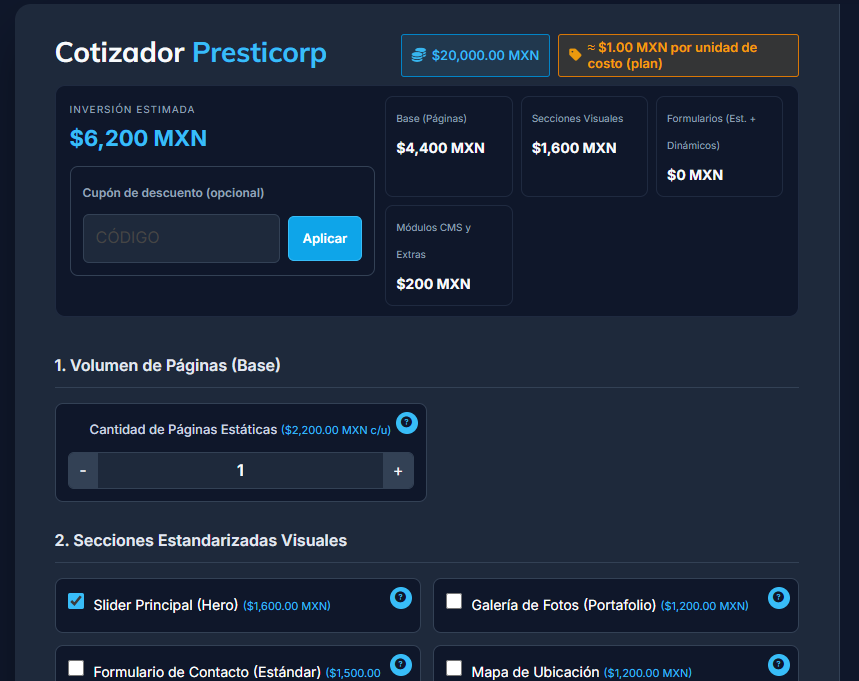
 Cotización de páginas web
Arma tu sitio por módulos y cotiza en MXN. Usarlo no tiene costo.
Cotización de páginas web
Arma tu sitio por módulos y cotiza en MXN. Usarlo no tiene costo.
 Convertidor de formatos
Convierte Excel, Word, PDF e imágenes. $150 MXN al mes, hasta 200.
Convertidor de formatos
Convierte Excel, Word, PDF e imágenes. $150 MXN al mes, hasta 200.
 Monitor Global
Clima, sismos, huracanes y tsunamis. Consulta gratis.
Monitor Global
Clima, sismos, huracanes y tsunamis. Consulta gratis.
 Promo a la vista
Catálogo gratis. Resumen gratis o desde $200/mes. Comida destacada: $500/mes.
Promo a la vista
Catálogo gratis. Resumen gratis o desde $200/mes. Comida destacada: $500/mes.
 Ravicom
Restaurantes y platillos. Buscar y registrar es gratis.
Ravicom
Restaurantes y platillos. Buscar y registrar es gratis.



Si tu proyecto requiere una solución más enfocada, entra directo a la landing ideal para tu negocio y envíanos tu información en el formulario correspondiente.
Ofertas vigentes del catálogo, de la más nueva a la más antigua.
Ver promociones Cupón Steam: Warhammer 40,000: Space Marine 2 a $199.99 (−75%, antes $799.99, vence 24 oct 2026)
Juego para PC Warhammer 40,000: Space Marine 2 (Steam, versión estándar) con 75% de descuento
Cupón Steam: Warhammer 40,000: Space Marine 2 a $199.99 (−75%, antes $799.99, vence 24 oct 2026)
Juego para PC Warhammer 40,000: Space Marine 2 (Steam, versión estándar) con 75% de descuento
 Guantes de Cardio Elite 2 Everlast a $399 en Everlast México (antes $849, −53%)
Guantes de Cardio Elite 2 Everlast
Guantes de Cardio Elite 2 Everlast a $399 en Everlast México (antes $849, −53%)
Guantes de Cardio Elite 2 Everlast
 Cargador UGREEN Nexode 65W Tipo C Carga Rápida GaNRobot color negro a $653.64 en UGREEN México (antes $1,257, −48%)
Cargador UGREEN Nexode 65W Tipo C Carga Rápida GaNRobot color negro
Cargador UGREEN Nexode 65W Tipo C Carga Rápida GaNRobot color negro a $653.64 en UGREEN México (antes $1,257, −48%)
Cargador UGREEN Nexode 65W Tipo C Carga Rápida GaNRobot color negro
 Robot aspiradora Roborock Q7 L5+ con estación de autovaciado a $6,799 en Roborock México (antes $15,999, −58%)
Robot aspiradora Roborock Q7 L5+ con estación de autovaciado
Robot aspiradora Roborock Q7 L5+ con estación de autovaciado a $6,799 en Roborock México (antes $15,999, −58%)
Robot aspiradora Roborock Q7 L5+ con estación de autovaciado










0 Comentarios