



Claude formalizes Fermat's Last Theorem in Lean: 11 days, 13 million lines

Claude formalizes Fermat's Last Theorem in Lean: 11 days, 13 million lines

09-09-2026 1:47:43
Compartir:

On September 4, 2026, Anthropic published an unusual milestone: an advanced prototype of Claude produced the first complete, computer-verified proof of Fermat's Last Theorem , written in the Lean proof assistant. This is not a "seems right" paper: Lean checks the logic step by step. In 11 days, the model wrote approximately 13 million lines and proved tens of thousands of intermediate theorems.

For product teams, AI startups, and SMEs already delegating reasoning to models, the useful message isn't "AI is already Wiles." It's this: when the volume of generated results exceeds what humans can manually review, formalization (translating the argument into verifiable code) becomes a layer of trust. This article summarizes the official announcement, the Prove2Me framework, and what questions to ask before including "auditable AI" in your roadmap.

What Anthropic announced on September 4

Latina researcher reviewing on laptop the Anthropic ad about the formalization of Fermat in Lean
September 4, 2026: Anthropic publishes the first computer-verified e2e proof of Fermat's Last Theorem

According to Anthropic's research post:

  • Claude worked largely independently for 11 days and produced the first e2e formalization of Fermat's Last Theorem in Lean.
  • The artifact is around ~13 million lines of Lean and on the order of ~29,500 intermediate theorems used in the final proof (Anthropic mentions ~30,300 theorems proven along the way).
  • The test follows a simplified exposition of Wiles' approach (via Darmon–Diamond–Taylor); human input was mostly high-level (sub-objective priority).
  • A comparator confirmed that the formal statement matches that of Mathlib; Lean verified the proof using only its three standard axioms.

Kevin Buzzard (Imperial College London), who leads the community effort to formalize FLT, called the result an extraordinary achievement of self-formalization and a step towards tools that ease the burden on referees and detect errors in the mathematical corpus.
Why it failed at first (and what changed with Prove2Me)

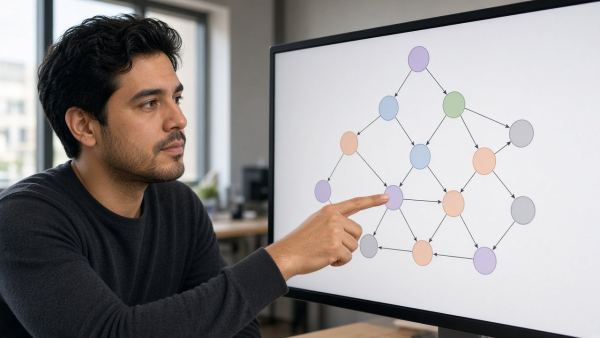
Latino engineer pointing to a DAG graph of theorems in Prove2Me while agents collaborate
Prove2Me: Lean theorem DAG, reuse, and compilation so that multiple agents do not lose state

Anthropic is explicit: the first multi-agent attempts stalled. Agents lost the project status and stopped collaborating effectively. The breakthrough came with the use of Prove2Me , an open collaborative formalization platform (Peng et al., Columbia), which:

  • maintains a DAG of statements to decide what to prove next;
  • separate statements and tests to speed up Lean compilation;
  • It stores descriptions in natural language to search for and reuse lemmas.

With that framework and a Claude Code-style multi-agent harness, the team closed the campaign in less than two weeks. Anthropic estimates that the internal research model, comparable to Claude Fable 5.1, generated around six billion tokens . Previous failed attempts contributed approximately 7% of the non-boilerplate lines in the final artifact.

What it means (and doesn't mean) for teams building with AI

Black math with braids contrasting a paper test with on-screen Lean code
13 million lines of Lean and ~29,500 intermediate theorems: verification, not just Elo

Three practical readings:

  • Verification ≠ discovery . Anthropic distinguishes this work from results where AI invents new mathematics: here the value is to check a known proof (Wiles) with the rigor of a formal assistant.
  • The bottleneck shifts . If models and humans generate more "proofs" or specs than the team can audit, asking the same stack to formalize or produce checkable artifacts (formal tests, contracts, Lean/ownership) can be cheaper than simply scaling up human review.
  • Orchestration is essential . The announcement isn't "a long chat." It's about DAGs, reuse, compilation, and agents that don't overlap. If your multi-agent product doesn't have reliable shared state, it will fail like the early FLT attempts.

Brief checklist if you sell or buy "verifiable AI":
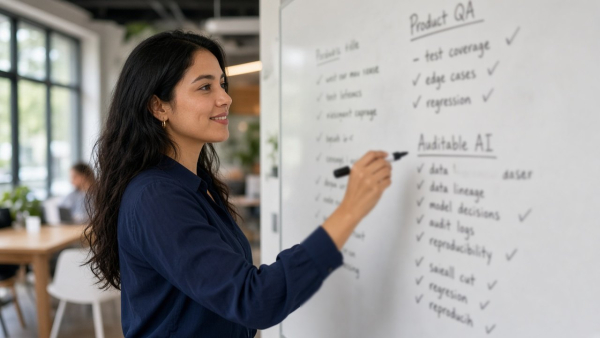
  • Which exact property is verified (Mathlib-equivalent statement, business invariant, security policy)?
  • Who signs the formal statement before the model "proves" it?
  • Is there a token/computing budget and a plan B in case the agent gets stuck?
  • Is the artifact reproducible (repo, hash, checker version)?

Reading for startups and product teams

Founder of a tech startup defining an auditable AI checklist on a product board
For product: formalization and testing as a layer of trust when AI generates more than humans can review.

You don't need to formalize Fermat. You do need to decide which parts of your system (payments, permissions, pricing, compliance) deserve a more rigorous approach than simply "the LLM said it's okay." Start with a narrow pilot: a formal specification or a set of properties with automated checkers; measure QA acceptance rate and time to green artifact. If you need to finalize that pipeline—product, landing page, and integration—at Presticorp we work by stage: startups , SMEs , and e-commerce .

The writer's suggestion

Treat the formalization of FLT as a sign of trust infrastructure , not as "superintelligence" marketing. This week, define: (1) which claim of your product would require a checker, (2) who writes the statement, and (3) what token and human review budget you're willing to accept. When AI generates more than it can read, the winner is the one with verification, not the one with the longest prompt.

Sources

  • Anthropic. "Formalizing Fermat's Last Theorem." September 4, 2026. See advertisement
  • NatureNews. "Anthropic AI 'formalizes' proof of Fermat's last theorem in just 11 days." September 7, 2026. See coverage
  • Chen, S., Marwaha, K., Lu, X., Yuen, H., & Peng, T. (2026). «Prove2Me: An open collaborative platform for scaling math formalization». arXiv:2608.28433. See paper

Editorial note: Line counts, theorems, tokens, and timelines are quoted as they appear in Anthropic's post of September 4, 2026. Lean/Mathlib and the public repo status may change; please check the GitHub linked from the announcement on the day you cite numbers in a business brief.

Compartir:

0 Comentarios

Deja un comentario

Landing pages especializadas

¿Proyecto totalmente personalizado? Contáctanos.

Si tu proyecto requiere una solución más enfocada, entra directo a la landing ideal para tu negocio y envíanos tu información en el formulario correspondiente.