




A startup doesn't run out of money because "development is expensive" in the abstract. It runs out of money because it builds too much, too late, or on a foundation that has to be scrapped when the first investor arrives or the first usage spike occurs. The MVP isn't an ugly version of the dream product. It's the smallest surface area that allows for learning: Does anyone use it, pay for it, or wait for the next version?
Presticorp's startup landing page presents agile development of minimum viable products, full-stack architecture (React, Node.js, TypeScript), cloud-native architecture, cross-platform apps, and DevOps practices. It offers a 90-day checklist and a four-step process. This article uses those service-based resources. It does not promise funding; that depends on the market, not the repository.
Burning capital on a product often looks like this: six months of a "final platform," three integrations no one asked for, a native app in two stores before reaching ten weekly users, and a backend that can't be deployed twice in the same day. The counterbalance isn't "doing it cheaply and poorly." It's about strategically narrowing down the scope.
Presticorp claims it will launch the product with essential functionalities “in weeks” and that the cloud infrastructure can grow “from 100 to 1 million users.” The latter is a stated architectural capability, not a traction forecast. The former is the pace you should demand: if the scope doesn't fit into visible sprints, the scope is poorly defined.

The landing page lists React, Node.js, and TypeScript , cloud-native development, web and mobile applications with a single codebase, and security with DevOps (CI/CD, monitoring, testing) from day one. It's not the only possible stack. It's one that a small startup can adopt, document, and later, internalize.
TypeScript in both front-end and back-end reduces the most costly bugs for a team of two or three: broken contracts between screens and APIs. None of this replaces a clear data model. The data model is almost always the most painful asset to migrate.
Presticorp describes the "idea to deployment" process in four stages. These serve as a working contract, whether executed by that company or another:
This pace aligns with the 90-day checklist that Presticorp offers on the same landing page: from idea to launch in a quarter, not a year of "we're almost there." If you want to compare reach, stage (idea/MVP/product already exists), and a quote, the published entry point is the web development landing page for startups , with a form and a stated response time of 24 hours.
The discipline of not burning capital is, above all, a list of exclusions:
Presticorp mentions using metrics to make data-driven decisions. That's correct at the scaling stage. In the MVP, three well-placed events are worth more than an empty warehouse. Symmetrical error—not measuring anything—is just as costly: you won't know if the product failed or if no one found it.

CI/CD, tests, and secrets outside the repository aren't second-rate luxuries. They're what allows you to fix a bug on Sunday without sending a ZIP file by email. The minimum viable operation:
That's not "bank security." It's hygiene. A startup that stores customer passwords and can't rotate them is already burning through capital that doesn't appear in the monthly burn report: trust and legal time.
On the landing page, Presticorp showcases its own projects—a job board with vacancies and applications, a certificate store with a payment gateway, a construction company website. These are examples of completed projects, not evidence that “your startup will raise a round of funding.” A reputable provider demonstrates the type of system it has built. A provider selling the unicorn dream is selling something else entirely.
Going from idea to MVP without burning through capital is a process of cutting costs: a hypothesis, a viable path, a stack the team can manage, sprints with demos, and an observable deployment. The cloud-native architecture and the full-stack React/Node/TypeScript framework that Presticorp lists are ways to avoid rewriting code after three months. They are not, on their own, traction.
Whether you're in the idea stage, the MVP stage, or working on a product that already needs scaling, the next step the company recommends is to review scope and cost at presticorp.com/landingpages/startups , including the 90-day checklist. Use it to narrow down your project, not to inflate your backlog.
Draft. Unpublished. Service facts (MVP in weeks, React/Node/TypeScript, cloud-native, cross-platform, DevOps, four-step process, 90-day checklist, quote form) taken from the official landing page for Web Development for Startups — Presticorp , accessed August 28, 2026. Scaling capabilities and portfolio case studies are provided by the company itself. This text does not fabricate fundraising or user metrics.
Enviando comentario…
 EmiteDocs
Constancias, diplomas, oficios y contratos en lote.
EmiteDocs
Constancias, diplomas, oficios y contratos en lote.
 CrearPlantillas
Editor visual de anuncios, plantillas y collage.
CrearPlantillas
Editor visual de anuncios, plantillas y collage.
 TuRSVP
Invitaciones digitales con RSVP para eventos.
TuRSVP
Invitaciones digitales con RSVP para eventos.
 Minitareas
Tableros personales para organizar el trabajo.
Minitareas
Tableros personales para organizar el trabajo.
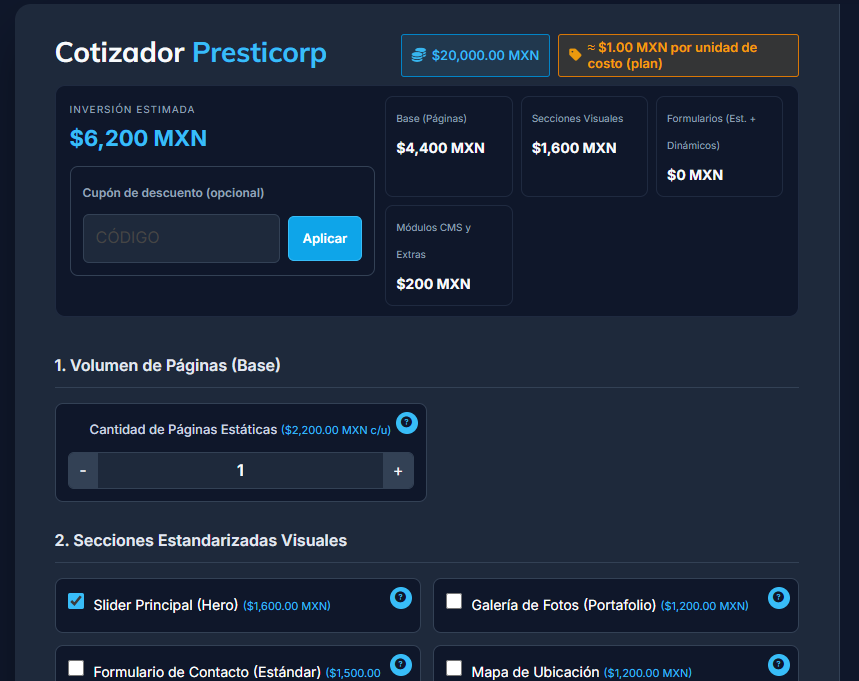
 Cotización de páginas web
Arma tu sitio por módulos y cotiza en MXN.
Cotización de páginas web
Arma tu sitio por módulos y cotiza en MXN.
 Convertidor de formatos
Convierte Excel, Word, PDF, imágenes y más, gratis y sin registro.
Convertidor de formatos
Convierte Excel, Word, PDF, imágenes y más, gratis y sin registro.


Si tu proyecto requiere una solución más enfocada, entra directo a la landing ideal para tu negocio y envíanos tu información en el formulario correspondiente.











0 Comentarios